Is Calvi Worth Visiting?
An honest, sourced answer to whether Calvi is worth visiting: boat trips to Scandola, the Balagne coast, the citadel, the little train to L'Île-Rousse, and how to get there.
Calvi is a town on the northwest coast of Corsica, the French Mediterranean island of 8,722 km2 with more than 1,000 km of coastline, and it is one of the island's established summer bases. It belongs to the Balagne, the region covered in detail on our Calvi and the Balagne area guide, and it pairs a port town with a citadel above the bay, a small airport of its own, and one of the shortest hops on the island to the UNESCO-listed Gulf of Porto. This page answers the question in full: what Calvi actually offers, what the facts say about getting there, and where it fits in a Corsica trip alongside the island's other bases covered across Corsica Travel Guide.
Where Is Calvi In Corsica?
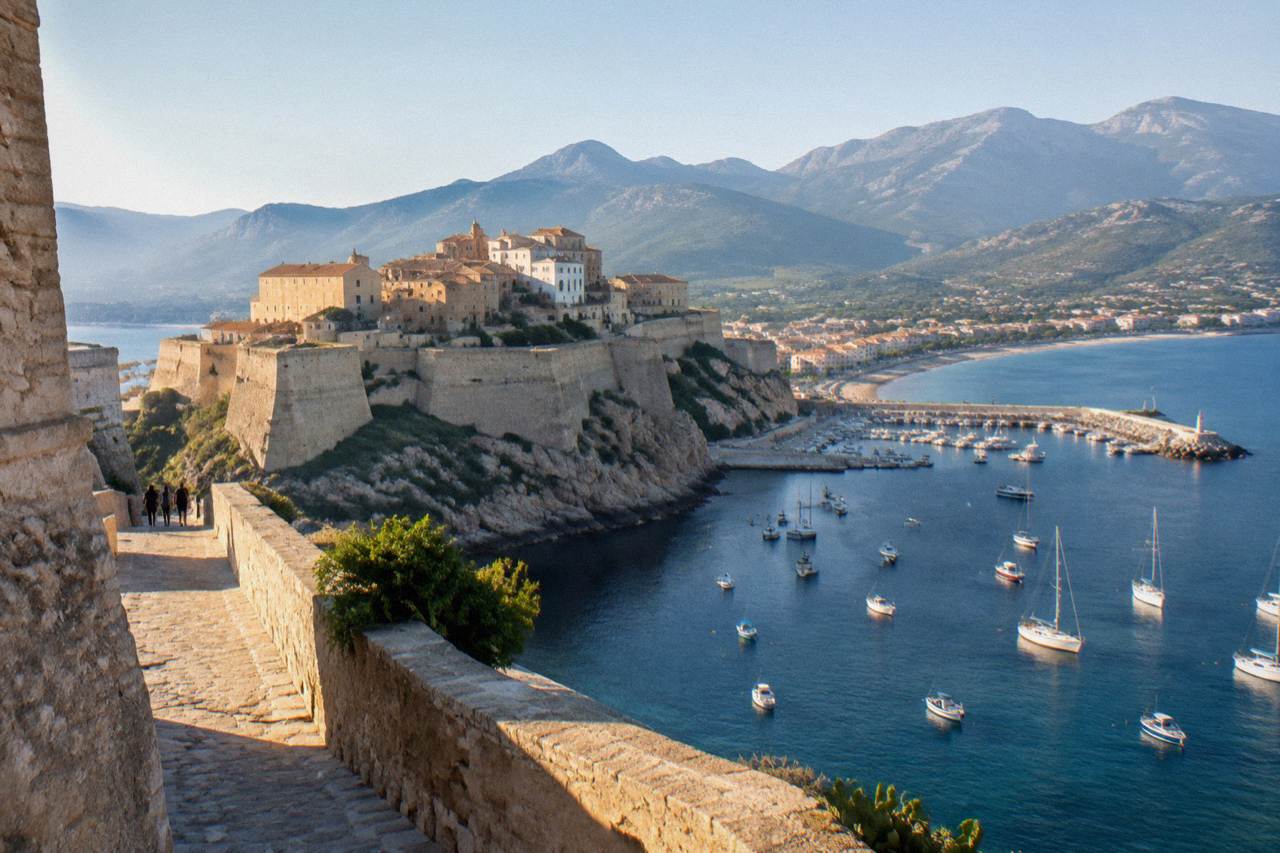
Calvi sits on the northwest coast of Corsica, in the Balagne region, facing the sea with the island's mountainous interior behind it. The town gives its name to the island's fourth airport, Calvi Sainte-Catherine (CLY), one of the four Corsican airports alongside Ajaccio, Bastia and Figari, and it is the western terminus of the Balagne coastal railway line that runs to L'Île-Rousse.
The Balagne is one of the recognisable regions of an island that counts 360 communes and a resident population, at the latest provisional INSEE estimate for 1 January 2026, of 365,636 people. Calvi's own citadel stands over the bay and is covered in our Calvi citadel guide. The Chemins de fer de la Corse, the island's railway network, runs a Ponte-Leccia to Calvi line and the Balagne coastal line between Calvi and L'Île-Rousse, which makes this stretch one of the few parts of Corsica you can explore without a car, a question addressed more broadly in do you need a car in Corsica.
On the road network, the drive time to Corte, the old capital in the interior, is one hour and thirty minutes from Calvi. Inforoutes Corse publishes live road conditions and accessibility levels for the main mountain passes, which matters on the narrow coastal and mountain routes of the northwest.
Is Calvi Worth Visiting?
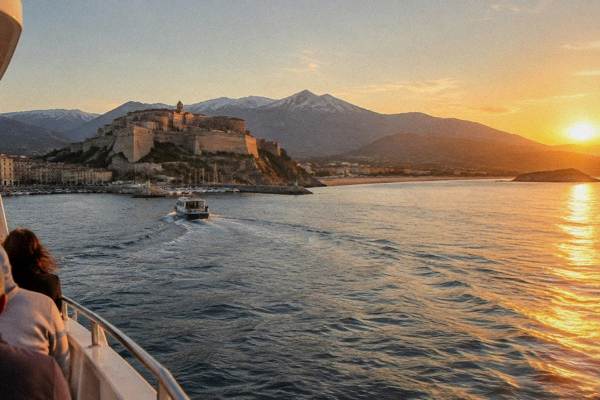
Yes, for two reasons: sea access and transport. Calvi is one of the practical departure points for boat trips towards the Scandola Nature Reserve and Girolata inside the UNESCO Gulf of Porto property, and it is the only Corsican base with its own airport, a mainline railway and a coastal train to L'Île-Rousse, so it works both as a destination and as a hub for the Balagne coast.
The UNESCO World Heritage property is "Gulf of Porto: Calanche of Piana, Gulf of Girolata, Scandola Reserve", inscribed in 1983 as dossier 258 under natural criteria (vii), (viii) and (x). Scandola itself is a nature reserve created by ministerial order on 9 December 1975, with 919 ha of land and 1,000 ha of sea, and its terrestrial part is closed to the public: visits are by boat only, reported on the reserve's own rule sheet. A sea trip from Calvi towards Scandola and Girolata is therefore one of the structured ways to see the property from the north, and our Calvi to Girolata and Scandola day trip guide lays out the full plan.
The second reason is the balance of the town itself. That spread, sea plus inland plus wine, is wider than many single-base towns on the island can offer.
What Boat Trips Run From Calvi?
The inventory from Calvi covers Scandola-bound boat tours, a sunset cruise to the Revellata peninsula, snorkelling trips at the edge of the Revellata marine reserve, and an introduction-to-diving experience with an instructor, alongside wine tastings and inland jeep tours sold from the same base. The wider Balagne area, including L'Île-Rousse, adds catamaran trips along the Désert des Agriates coast.
On the water, the flagship is the sea trip from Calvi towards Scandola, the boat-only reserve inside the UNESCO property. Closer to home, the sunset cruise to the Revellata peninsula and the snorkelling trip at the edge of the Revellata marine reserve keep travel time short while still putting you on the water. For beginners, an instructor-led introduction to diving runs from Calvi, and there is a combined boat trip and snorkelling outing in the Gulf of Calvi.
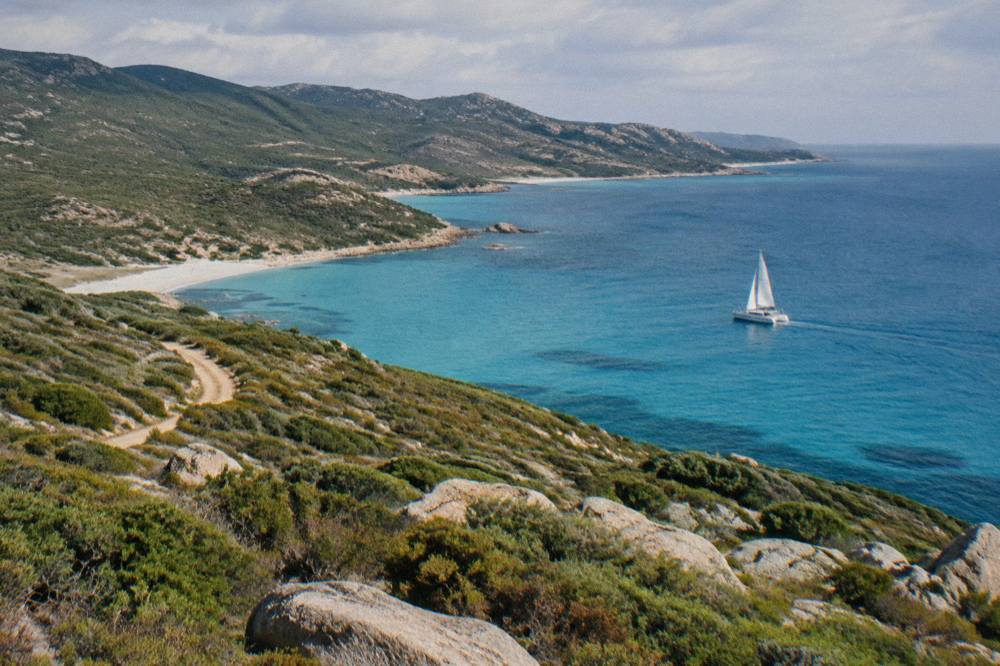
The standout day on the coast east of Calvi is the full-day catamaran trip in the Désert des Agriates departing from L'Île-Rousse, a short hop along the coast. The Désert des Agriates beaches, Saleccia and Lotu, are otherwise reached by boat shuttle from Saint-Florent, by 4x4 track from Casta, or on foot, per the island's tourism body. A jeep tour to Lotu and Saleccia from Calvi is also among the products on this page.
The table below gathers the tour families sold from Calvi and the nearby Balagne coast.
| Tour family | Products from the area | Coverage |
|---|---|---|
| Sea cruises | Calvi to Scandola boat tour | The UNESCO Gulf of Porto reserve by sea |
| Sunset cruises | Sunset cruise to the Revellata peninsula | Evening sail from Calvi |
| Snorkelling and diving | Revellata marine reserve snorkelling, Gulf of Calvi boat and snorkel trip, introduction to diving with an instructor | Mask and fins around the gulf |
| Catamaran days | Full-day catamaran trip in the Désert des Agriates from L'Île-Rousse | The Agriates coastline east of Calvi |
| Inland jeep and 4x4 | Agriate jeep tour to Lotu and Saleccia, Asco valley 4x4 day tour | Beaches and the mountain interior |
| Wine | Wine tastings around Calvi and Île-Rousse, private wine tour with picnic | Corsican appellations from the Balagne |
How Do You Get To Calvi?
Calvi is reached by air through Calvi Sainte-Catherine airport (CLY), by rail on the Chemins de fer de la Corse Ponte-Leccia to Calvi line, by road with a one hour and thirty minute drive time to Corte, or by sea via the island's ferry ports, the nearest of which include L'Île-Rousse and Bastia. There is no airport-to-airport shortcut: the four Corsican airports are Ajaccio Napoléon Bonaparte, Bastia Poretta, Figari Sud Corse and Calvi Sainte-Catherine.
The airport side of the question is covered in our Calvi airport guide. On the rail side, the Chemins de fer de la Corse run three elements: the Ajaccio to Bastia line via Corte, the Ponte-Leccia to Calvi line, and the Balagne coastal line between Calvi and L'Île-Rousse, so a visitor based in Calvi can ride the coastal line without a car and connect towards the mainline network. The wider question of ferries, mainland ports and operators is treated in how do you get to Corsica.
The road network is where Corsica needs planning. The island's mountain roads are monitored through Inforoutes Corse, which publishes live conditions and pass accessibility, and the driving time for Calvi to Corte, the inland old capital, is ninety minutes. From Corte the times are a further one hour to Bastia, one hour thirty to Ajaccio, two hours to Porto-Vecchio and two hours forty-five to both Bonifacio and Propriano, which lets you place Calvi on any wider loop. Other pages covering the same trip are gathered on Corsica Travel Guide.
| Way in | What the verified facts say |
|---|---|
| Air | Calvi Sainte-Catherine (CLY), one of four Corsican airports |
| Rail, mainline | Chemins de fer de la Corse, Ponte-Leccia to Calvi line |
| Rail, coastal | Balagne line, Calvi to L'Île-Rousse |
| Road anchor | Calvi to Corte, 1 h 30 |
| Ferry ports on the island | Ajaccio, Bastia, Bonifacio, L'Île-Rousse, Propriano, Porto-Vecchio |
What Does The Balagne Add Around Calvi?
The Balagne adds walking country, hilltop villages and wine around Calvi: the Mare e Monti Nord long-distance trail runs 121 km over ten days with 6,100 m of climbing and ends at Cargèse, the Mare a Mare Nord runs 139 km, or 161 km with its variant, in 8 to 12 days, and the region's wine country produces under the Vin de Corse appellation with Calvi among its named crus.
The trail figures come from the PNRC brochure on the island's long-distance paths, and they matter here because two of the island's big itineraries pass through or near the Balagne. A day tour of old hilltop villages from Calvi is also available for booking for visitors who want the interior without committing to a multi-day walk. For the appellations, the island's wine names include Patrimonio, Ajaccio, Vin de Corse with its named crus such as Calvi, Coteaux du Cap Corse, Figari, Porto-Vecchio and Sartène, and Muscat du Cap Corse, with Nielluccio and Sciaccarellu as the main red grapes and Vermentinu the white.
Food and drink around the island follow the same pattern of protected names: brocciu, the sheep's or goat's milk cheese, obtained its appellation d'origine in 1983; the charcuterie trio of prisuttu, lonzu and coppa took AOC in 2012 and AOP in 2014; chestnut flour, Corsican honey, olive oil and the Clémentine de Corse all carry protected designations. The question of what is the famous food in Corsica covers the plate in full, and wine tasting around Calvi and Île-Rousse is sold as a hallmark of the region.
When Should You Visit Calvi?
The Météo-France station normals for the region show a hot, dry summer and a mild, wet winter: July averages 8.6 mm of rain at Ajaccio against 111.8 mm in November, August carries the highest mean daily high at 29.2 °C at Ajaccio and 29.8 °C at Bastia, and snow falls only on the high mountains, so the choice of month is a trade between summer weather and winter quiet that no official source ranks for you.
The two closest long-run stations to the Balagne are Ajaccio (Campo dell'Oro) and Bastia, both 1991-2020 normals. At Ajaccio, the mean daily high climbs from 14.0 °C in January to 29.2 °C in August, with sunshine averaging 12.1 hours a day in July; at Bastia the same figures run from 13.8 °C in January to 29.8 °C in August. Rain at Ajaccio totals 635.0 mm across the year and at Bastia 816.9 mm, with October and November carrying the larger monthly totals at both stations. The month-by-month detail is in our Corsica weather guide and in what is the best month to visit Corsica.
One seasonal rule matters more in the interior than on the coast: from 15 June to 30 September it is forbidden to light a fire or smoke in forests, maquis and massifs, and a daily fire-risk map is published at 18:00 for the next day, with access to some massifs restricted from mid-June to mid-September. The UK FCDO notes a high wildfire risk in France from April to October. For walkers heading into the hills from the Balagne, that is the constraint to plan around.
Is Calvi Worth Visiting Compared With Corsica's Other Bases?
Compared with Ajaccio, Bastia, Bonifacio and Porto-Vecchio, Calvi's advantages are its own airport, the coastal railway to L'Île-Rousse, and the northern sea route towards Scandola, while the other bases hold the island's biggest museums and the southern cliff coastline, so the honest answer is that Calvi earns its slot on a two-base or three-base itinerary rather than as a substitute for the whole island.
Ajaccio, the capital with 76,320 residents, holds Maison Bonaparte and the Palais Fesch; Bastia, at 46,867 residents, is the second town and the main ferry gateway from Italy; Bonifacio owns the cliffs and the Îles Lavezzi; Porto-Vecchio fronts the beaches of the southeast. Calvi's counterweight is the Balagne package: citadel, port, beach, airport, train and the northern approach to the UNESCO property. If the itinerary allows more than one base, the planning question of how many days in Corsica is enough sets the frame, and is Corsica worth visiting covers the island-level case.
Corsica is the fourth-largest island in the Mediterranean, with Monte Cinto at 2,706 m as its highest summit, so both sea and serious mountain sit within reach of any single base. Calvi puts the sea at the door and the Asco valley, one valley of that mountain interior, a 4x4 day tour away.
Common Questions About Calvi
These are the questions readers ask most about Calvi in Corsica, answered from the facts on this page: the town is worth visiting for its sea access and transport links, the citadel stands over the bay, the airport code is CLY, and the coastal train runs to L'Île-Rousse. Each answer below keeps to what the record supports and nothing beyond it.
Is Calvi Worth Visiting?
Yes. Calvi combines a citadel, a port and a beach in one base, an airport of its own (CLY), the Balagne coastal railway to L'Île-Rousse, and boat access towards the Scandola Nature Reserve inside the UNESCO Gulf of Porto property, which is visitable by boat only.
Can You Get To Scandola From Calvi?
A Calvi to Scandola boat tour is among the bookable products. Scandola's terrestrial part is closed to the public and visits are by boat only, reported on the reserve's rules, with no landing in the integral reserve and daytime anchoring allowed outside protected zones.
Is There A Train From Calvi?
The Chemins de fer de la Corse run the Ponte-Leccia to Calvi line and the Balagne coastal line between Calvi and L'Île-Rousse. Timetables are published by the railway, and the network's third element is the Ajaccio to Bastia line via Corte.
How Far Is Calvi From Corte?
The road time is one hour thirty minutes. From Corte, allow one hour to Bastia, one hour thirty to Ajaccio, two hours to Porto-Vecchio and two hours forty-five to Bonifacio or Propriano.
What Is The Weather Like In Calvi?
The nearest long-run stations in the climate set are Ajaccio and Bastia. Both show a hot, dry summer, with August mean daily highs of 29.2 °C at Ajaccio and 29.8 °C at Bastia, and a mild, wet winter, with November carrying the larger monthly rain totals at both stations.
Do You Need A Car In Calvi?
Not for the essentials. The coastal train links Calvi to L'Île-Rousse, boat trips and jeep tours cover the sea and the Agriates, and wine tastings around Calvi and Île-Rousse run as guided products. A car widens the island loop, and the trade-offs are set out in our guide on whether you need a car in Corsica.
For a town of its size, Calvi holds a rare hand: sea, citadel, rail, an airport and the northern door to the Gulf of Porto, which is why the answer to the question in the title stays yes for anyone whose Corsica trip has room for the Balagne coast.