Corsica Solo Travel
Corsica rewards people travelling on their own: small-group boat trips, walkable towns, a train line along the coast and mountain trails with booked refuges. This guide sets out the practical side of doing it alone.
Yes. Corsica works well for solo travel: the main towns are walkable, group tours fill the gaps a car-free traveller would otherwise face, the Chemins de fer de la Corse links Ajaccio, Bastia and Calvi, and emergency cover is the standard French system (112 for everything).
Corsica is a French Mediterranean island of 8,722 km2 with more than 1,000 km of coastline and a mountainous interior that rises to Monte Cinto at 2,706 m, and it is a destination that suits a traveller arriving alone. The reasons are structural rather than sentimental: the population of 365,636 (provisional INSEE estimate for 1 January 2026) is concentrated in a handful of towns connected by rail, the tour supply is built around small-group boat trips and guided walks that a single person can join without a supplement, and the island's walking network, from the GR20 to the Mare a Mare routes, is run on a booking system that treats one walker exactly the same as a group of four. This page from the Corsica Travel Guide sets out what the sources say about going solo: where to base yourself, how to move around, what the rules are on the trails, and what a week alone on the island can look like.
Is Corsica Good For Solo Travel?
Yes. Corsica suits solo travel because its activity supply is built around join-in group experiences rather than private parties: small-group boat cruises, guided walking tours and instructor-led dives all sell per person, the main towns of Ajaccio (76,320 residents) and Bastia (46,867) are compact enough to explore on foot, and a public rail network links the north and south coasts. Nothing on the island requires a party of two.
The join-in economy matters more here than in a big city. Scandola, the Calanques de Piana, Girolata and the Îles Lavezzi are seen from the water, and the crossings run as scheduled departures that individuals book onto, from ports including Porto, Cargèse, Sagone, Calvi, Ajaccio, Bonifacio and Porto-Vecchio. A solo traveller is the normal customer on those decks, not an exception.
On land the same logic applies. The Parc naturel régional de Corse, created in 1972 and now covering 4,484 km2, runs its long-distance trails on a refuge-booking platform that charges per person per night, so a lone walker plans exactly like everyone else. And the practical layer, emergency numbers, the euro, the Europe/Paris timezone, is the standard French system, which most solo travellers already know how to use.
Where Should You Base Yourself Alone In Corsica?
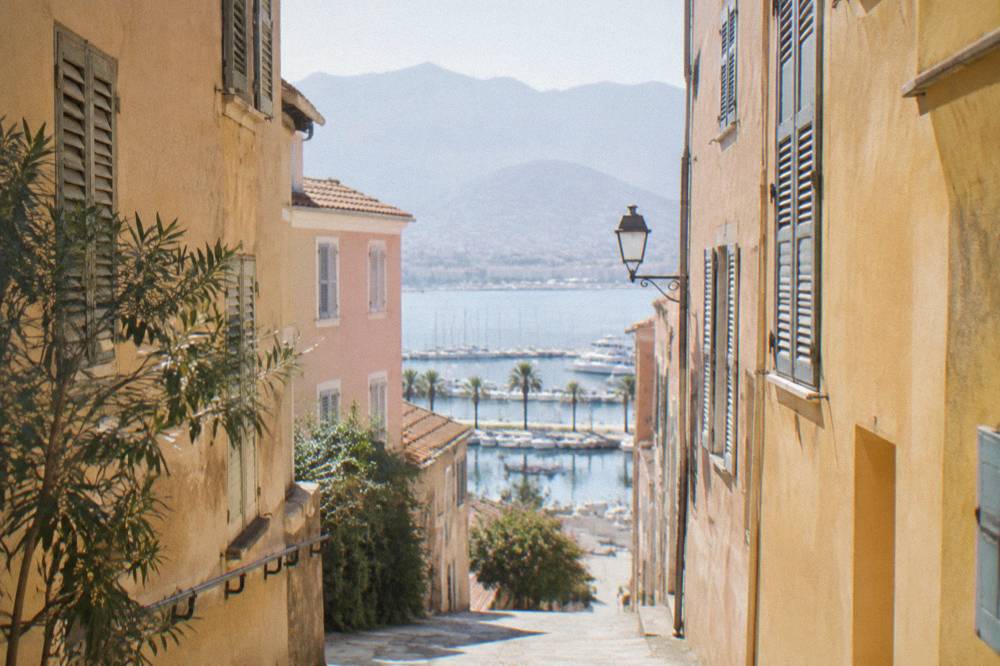
For a first solo trip, Ajaccio and Bastia are the two bases that need no car at all: both are ferry ports, both sit on the Chemins de fer de la Corse network, and both have walkable historic centres. Bonifacio and Porto-Vecchio work for a beach-and-boats week in the far south, Calvi and L'Île-Rousse for the Balagne, and Corte for the mountains, though Corte and the interior are inland and need more planning.
| Base | Why it works solo | Getting there without a car |
|---|---|---|
| Ajaccio | Capital, ferry port, museums, Sanguinaires boat trips | Ferry port and Ajaccio Napoléon Bonaparte airport (AJA) |
| Bastia | Second town, old harbour, Cap Corse and Agriates trips | Ferry port and Bastia Poretta airport (BIA) |
| Bonifacio | Cliffs, citadel, Lavezzi cruises from the marina | Ferry port (Santa Teresa Gallura link) and Figari Sud Corse airport (FSC) |
| Calvi | Balagne beaches, citadel, Scandola and Revellata trips | Ferry port and Calvi Sainte-Catherine airport (CLY) |
| Corte | Old capital, inland, Restonica and museum | Rail stop on the Ajaccio to Bastia line |
Ajaccio deserves the longest look for a first-timer. Maison Bonaparte, the national museum on Rue Saint-Charles, is 200 m from the bus station and the ferry terminal, and bus 8 runs from the airport, so a solo arrival with luggage involves almost no logistics. The museum is open every day except Monday, with hours of 10:00 to 17:30 from 1 July to 30 September, and admission is EUR 10 full price, free for EU residents under 26. Palais Fesch lists EUR 10 full, EUR 6 for over-65s and free up to 18, daily 09:00 to 17:00, per the Ajaccio tourist office listing for the 16 January to 31 December 2026 period.
Bastia is the working alternative: the old harbour is the centrepiece, the Musée de Bastia in the Palais des Gouverneurs keeps high-season hours of 10:00 to 18:30, and the Cap Corse and Agriates guided trips depart from the Saint-Florent side of the peninsula. For a deeper comparison of the island's regions before choosing, see Corsica In One Week.
What Can You Do Alone In Corsica?
The solo-friendly list is long: join-in boat cruises to Scandola, the Calanques de Piana, the Îles Sanguinaires and the Îles Lavezzi, small-group food and wine tours in Ajaccio and Calvi, guided history walks in Ajaccio and Bastia, instructor-led dives and snorkelling trips, canyon descents near Bocognano, and small-group day trips to the hilltop villages, Cap Corse and the Désert des Agriates. Every one of these sells by the person.
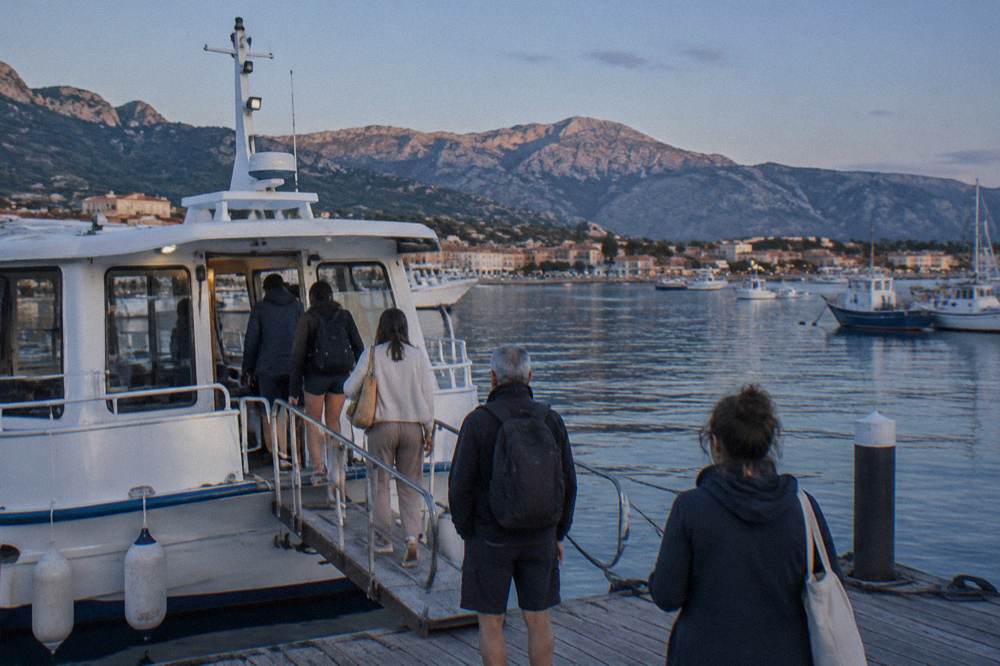
The boat layer is the core of a Corsican week. From Porto and the Golfe de Porto, cruises cover the Scandola Nature Reserve and the Calanche of Piana, part of the UNESCO property "Gulf of Porto: Calanche of Piana, Gulf of Girolata, Scandola Reserve", inscribed in 1983. Scandola's land area is closed to the public and visits are by boat only, reported by the reserve's managing body, so the cruise is not one option among several, it is the only option. Several Porto departures include a stop at Girolata, the hamlet reachable from the sea.
On land, the inland day trips are the ones a solo traveller without a car should book earliest. A small-group tour of the old hilltop villages runs from the Calvi side and covers ground that public transport does not reach; you can see the details and dates on the hilltop villages day trip page's neighbour, or read the full Sanguinaires boat trip guide for the coastal half of the island. In Ajaccio itself, food tours with tastings, a history walk from Genoa to Napoléon, and a Napoleon's Cave visit with a Corsican meal all run as small-group or per-person products.
How Do You Get Around Corsica Alone?
The Chemins de fer de la Corse run three lines, Ajaccio to Bastia via Corte, Ponte-Leccia to Calvi, and the Balagne coastal line between Calvi and L'Île-Rousse, and they are the solo traveller's backbone: they link four of the main bases directly and the Balagne line serves the beaches between Calvi and L'Île-Rousse. Ferries and four airports cover arrival, and Inforoutes Corse publishes live road conditions for anything driven.
The rail network is narrow-gauge and slow, but it exists, and for a traveller alone it removes the single biggest cost and complication of the island, which is driving mountain roads. Reported by the operator's timetable pages, the lines connect Ajaccio, Corte, Ponte-Leccia, Bastia, Calvi and L'Île-Rousse. The Balagne stretch between Calvi and L'Île-Rousse hugs the coast and doubles as a beach shuttle in summer.
For arrival, the four airports are Ajaccio Napoléon Bonaparte (AJA), Bastia Poretta (BIA), Figari Sud Corse (FSC) and Calvi Sainte-Catherine (CLY). The ferry ports are Ajaccio, Bastia, Bonifacio, L'Île-Rousse, Propriano and Porto-Vecchio, served from Marseille by Corsica Linea and La Méridionale, from Toulon, Nice, Livorno and Savona by Corsica Ferries, from Livorno and Genoa by Moby, and from Santa Teresa Gallura in Sardinia to Bonifacio by Moby and Ichnusa Lines. More than 8.5 million passengers excluding cruise passengers passed through Corsica's ports and airports in 2025, per the ORTC and DREAL annual report published 30 May 2026.
Is Corsica Safe For Solo Travellers?
Corsica carries the standard France advisory framework, and nothing in it singles the island out: the UK FCDO notes a high wildfire risk in France from April to October, and the US State Department lists France at Level 2, Exercise Increased Caution. The island's own specific rules are the fire ban from 15 June to 30 September, when no fires or smoking are allowed in forests, maquis and massifs, and the daily massif-access map updated at 18:00 for the next day.
The emergency layer is the national one, and a solo traveller should have it saved before arrival:
| Number | Use |
|---|---|
| 112 | European emergency number |
| 15 | SAMU medical emergency |
| 17 | Police |
| 18 | Fire service |
| 114 | SMS or app, for deaf or speech-impaired callers |
| 196 | Sea rescue (VHF channel 16 at sea) |
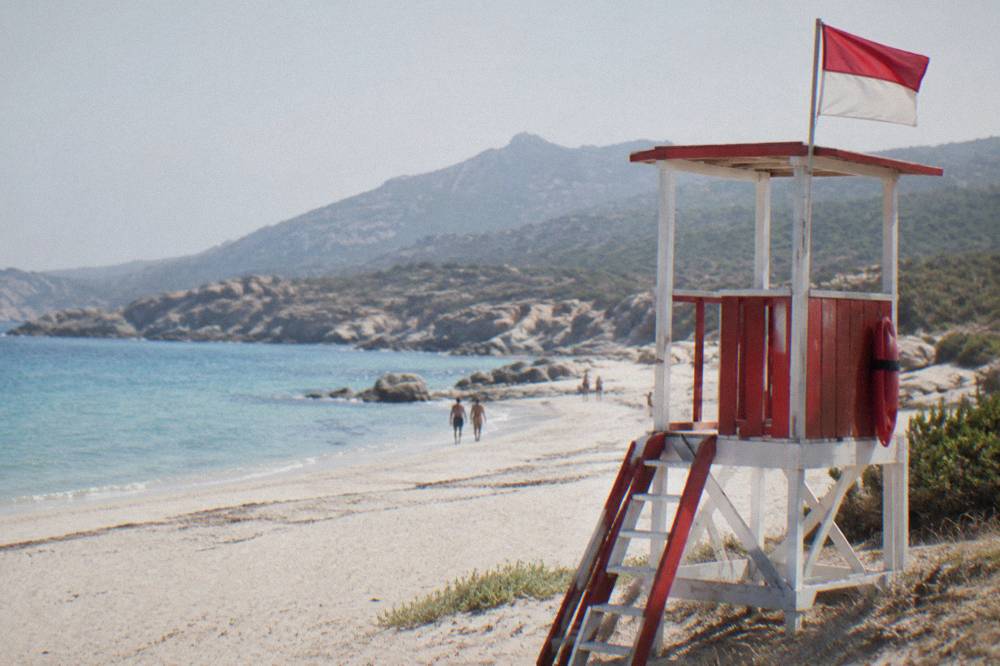
For the mountains specifically, the PGHM mountain-rescue base at Ajaccio can be reached on 04 95 24 24 00, with 112 or 17 in an emergency. At sea, Ajaccio operated seven lifeguard posts on its main beaches from 1 July to the end of August 2026, and Haute-Corse's supervised beaches are staffed by volunteer firefighters roughly 1 July to 31 August. The practical reading for a solo visitor: swim at supervised beaches in summer, treat the fire rules as hard law rather than advice, and check the massif-access map before any day in the high country. For more on this, see First Time In Corsica.
Can You Eat And Drink Alone In Corsica?
Yes, and the pricing system works in the solo diner's favour: French law requires menus to state "prix service compris" with the service percentage included, per the DGCCRF, so the bill for one is the menu price with no expected supplement and no tipping obligation, an extra tip being optional. Corsica's food culture is also built around single-serving products, brocciu, figatellu, lonzu, coppa and prisuttu, and sweets like fiadone and canistrelli.
A counter lunch or a terrace dinner for one is unremarkable in the towns. The island's protected foods give the solo menu its shape: brocciu obtained its appellation d'origine in 1983 and its AOC in 1998, the three charcuterie cuts prisuttu, lonzu and coppa took AOC in 2012 and AOP in 2014, chestnut flour holds an AOP, olive oil an AOC effective 2004, honey an AOP, and the Clémentine de Corse an IGP since 2007. A platter and a cheese course for one covers most of that list.
Wine follows the same pattern. Corsican appellations include Patrimonio, Ajaccio, Vin de Corse with its named crus such as Calvi, Coteaux du Cap Corse, Figari, Porto-Vecchio and Sartène, and Muscat du Cap Corse, with Nielluccio and Sciaccarellu as the main red grapes and Vermentinu the white. A guided tasting solves the solo problem of not wanting a whole bottle: food and wine tours with tastings run in Ajaccio, and wine-tasting experiences operate around Calvi and L'Île-Rousse. For depth, read Corsican Food And What To Eat alongside this page.
Can You Hike Solo In Corsica?
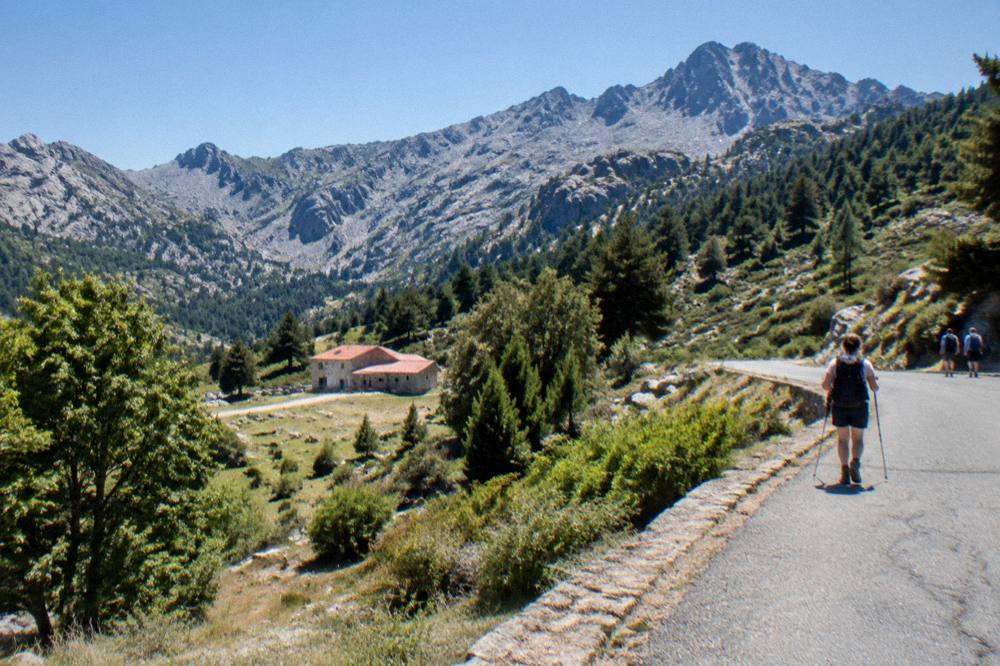
Yes, on a booking system designed for individuals: the GR20 is 180 km north to south in about 15 stages of 4 to 8.5 hours, refuge nights must be booked online in advance, and 2026 PNRC rates are EUR 20 per person for a refuge bunk, EUR 12 for a bivouac pitch, EUR 27 for a rented tent for one and EUR 39 for two. Wild camping is banned, dogs are not allowed in refuges or rented tents, and no departures from Calenzana are allowed after 11:00.
The GR20, guarded refuges open 16 May to 4 October inclusive in 2026, is the headline walk, and the PNRC's own page sets the rules: reservations are obligatory for every option, online only, with changes possible up to 48 hours before a stage. The old Cirque de la Solitude section has been off the route since a fatal rockfall in 2015 and a variant replaces it. For a solo walker the platform removes the usual anxiety of turning up and finding a full hut.
| Trail | Length | Days | Total climb |
|---|---|---|---|
| GR20 (Fra li Monti) | 180 km | about 15 stages | stated as 4 to 8.5 h per stage |
| Mare e Monti Nord | 121 km | 10 | 6,100 m |
| Mare a Mare Nord | 139 km (161 km with variant) | 8 to 12 | 5,900 m |
| Mare a Mare Centre | 84 km | 6 to 7 | 3,900 m |
| Mare a Mare Sud | 73 km | 5 | 3,200 m |
| Mare e Monti Sud | 66 km | 5 | 2,700 m |
For a first solo visit, Mare a Mare Centre or Sud is a gentler proposition than the GR20: both end at reachable towns (Porticcio for the Centre's southern variant, Propriano for the Sud), and 84 km and 73 km respectively split into day-size stages per the PNRC brochure. The fire rules apply to all of it: from 15 June to 30 September, no fires or smoking in forests, maquis and massifs, and the daily access map can close some massifs entirely on high-risk days. A related question, walking the GR20 alone, is covered on the GR20 guide's sister pages, including whether it is safe to hike alone.
What Does Solo Travel In Corsica Cost?
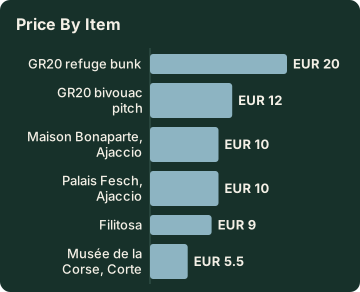
The fixed, verifiable costs a solo traveller can plan around are sight admissions and refuge nights: Maison Bonaparte EUR 10, Palais Fesch EUR 10, Musée de la Corse in Corte EUR 5.50 with one ticket covering museum and citadel, Filitosa EUR 9 adults open 1 April to 2 November, and GR20 refuge bunks at EUR 20 per person per night.
The single-suplication question, whether a lone traveller pays double, mostly disappears on this island because the two big variable costs, boat trips and refuge nights, are per-person by nature. Here is what the fixed list looks like:
| Item | Price | Notes |
|---|---|---|
| Maison Bonaparte, Ajaccio | EUR 10 | EUR 8 non-EU 18-25 and large families, free EU under 26, closed Monday |
| Palais Fesch, Ajaccio | EUR 10 | EUR 6 over 65, free up to 18 |
| Musée de la Corse, Corte | EUR 5.50 | EUR 4 reduced, EUR 3 over-65s and young people, ticket covers citadel |
| Filitosa | EUR 9 | EUR 7 reduced, family EUR 28, open 1 April to 2 November |
| Escalier du Roi d'Aragon, Bonifacio | about EUR 5 | 189 steps, closed shoes required |
| GR20 refuge bunk | EUR 20 | per person per night, booked online |
| GR20 bivouac pitch | EUR 12 | own tent, per person |
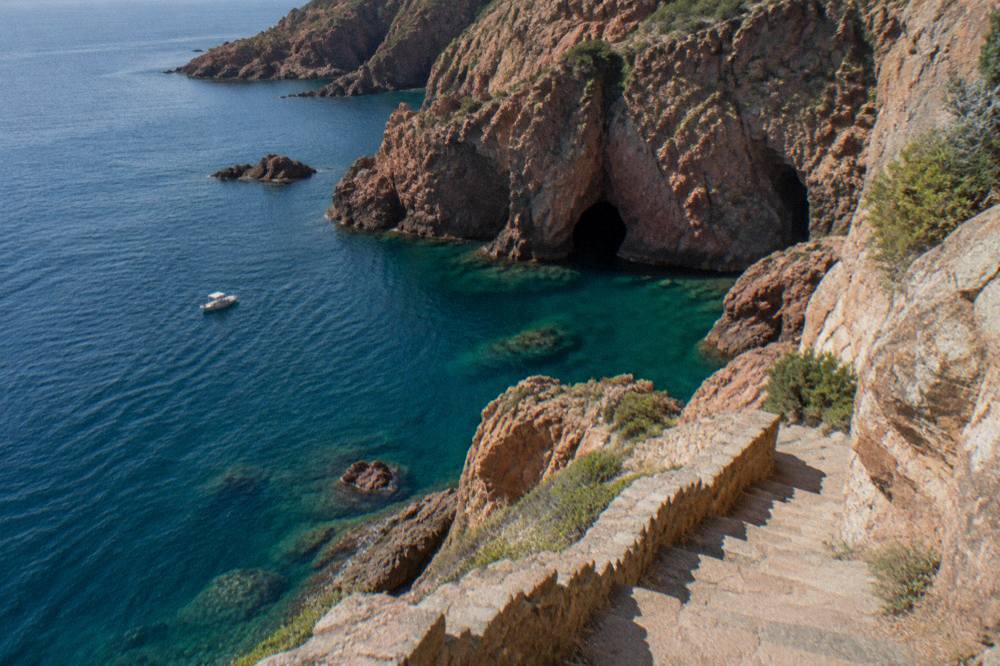
The Escalier du Roi d'Aragon deserves its line for a solo morning in Bonifacio: 189 steps cut down the cliff with a 180-degree view over the strait towards Sardinia, and children get a "diploma" at the top, per the Bonifacio reservation site, which is a detail that tells you the descent is family traffic rather than a mountaineering proposition.
What Is A Good One-Week Solo Itinerary In Corsica?
A workable solo week splits the island in two: three nights in Ajaccio for the Sanguinaires, the museums and a Scandola or Bonifacio day cruise, then three nights in Bastia or Calvi for the Balagne coast, the hilltop villages day trip and the train ride between them, with the seventh day left loose for weather. The Chemins de fer de la Corse Ajaccio to Bastia line via Corte carries the transfer, and Corte itself makes a one-night inland stop if the museum and the Restonica appeal.
A day-by-day shape:
| Day | Base | Plan |
|---|---|---|
| 1 | Ajaccio | Arrive, Maison Bonaparte or Palais Fesch, old town on foot |
| 2 | Ajaccio | Sanguinaires boat trip or aperitif sunset cruise from the gulf |
| 3 | Ajaccio | Full-day cruise: Scandola and Piana, or Bonifacio by sea |
| 4 | Corte | Train via the interior line, Musée de la Corse and citadel, EUR 5.50 |
| 5 | Calvi or L'Île-Rousse | Balagne coastal train, beaches between the two towns |
| 6 | Calvi | Hilltop villages small-group day trip, or Revellata snorkelling |
| 7 | Bastia | Train north, old harbour and Musée de Bastia, depart |
The order can be reversed from Bastia inward if the ferry or flight arrives there. What the plan deliberately avoids is daily long drives: each day uses a walkable base and a per-person departure, which is exactly the structure a solo traveller wants. If the week stretches to ten days or two, the longer plans in Corsica In 10 Days and Corsica In 14 Days inherit the same logic.
When Should You Travel Alone In Corsica?
The Météo-France station normals for Ajaccio, 1991 to 2020, show the pattern a solo planner needs: July averages 8.6 mm of rain and 12 h 6 min of sunshine a day, August has the highest mean daily high at 29.2 °C, and November carries 111.8 mm of rain, with October at 85.7 mm. Bastia's normals run wetter in autumn, 134.3 mm in November and 126.5 mm in October, so late autumn is the season to build indoor days around.
| Month | Ajaccio high °C | Ajaccio rain mm | Ajaccio sunshine h/day | Bastia rain mm |
|---|---|---|---|---|
| Jan | 14.0 | 54.1 | 4.4 | 67.3 |
| Mar | 16.0 | 50.4 | 6.8 | 63.7 |
| May | 22.1 | 49.8 | 9.3 | 53.7 |
| Jul | 28.6 | 8.6 | 12.1 | 13.8 |
| Sep | 26.1 | 57.8 | 8.7 | 74.5 |
| Nov | 18.3 | 111.8 | 4.7 | 134.3 |
Two seasonal anchors matter more than the rainfall columns for a solo plan. The GR20 refuges are guarded only from 16 May to 4 October, so the walking season is fixed regardless of weather preference. And supervised beaches operate roughly 1 July to 31 August, which frames the swimming season. Between those two windows, late May to June and September, the whole island is in season without either constraint being missed. For wet-day options, Corsica In The Rain exists for a reason.
Common Questions About Solo Travel In Corsica
Is Corsica Safe For Solo Travellers?
Corsica falls under the standard France advisories: the UK FCDO notes a high wildfire risk in France from April to October, and the US State Department lists France at Level 2, Exercise Increased Caution. The island's specific rules are the 15 June to 30 September fire and smoking ban in forests, maquis and massifs, plus the daily massif-access map. Emergency numbers are 112, 15, 17, 18, 114 and 196 at sea, and PGHM mountain rescue in Ajaccio is 04 95 24 24 00.
Do You Need A Car In Corsica As A Solo Traveller?
No, though it depends on the base. Ajaccio, Bastia, Calvi and L'Île-Rousse sit on the Chemins de fer de la Corse network, and small-group day trips by boat, jeep or minibus cover the car-only destinations such as the hilltop villages, Cap Corse and the Désert des Agriates. Corte is reachable by train via the Ajaccio to Bastia line.
Can You Do The GR20 Solo?
Yes. Refuge and bivouac nights are booked online per person through the PNRC platform, at EUR 20 for a bunk and EUR 12 for a bivouac pitch in 2026, with refuges guarded 16 May to 4 October. The rules that matter most to a lone walker: no departures from Calenzana after 11:00, wild camping is banned, and the fire-risk map is updated at 18:00 daily for the next day.
Is It Awkward To Eat Alone In Corsica?
No. Service is included in menu prices by French law, so the bill for one is the printed price with no supplement, and an extra tip is optional. Corsican menus translate well to a table for one: charcuterie of prisuttu, lonzu and coppa, brocciu in sweet or savoury form, and single-portion sweets like fiadone and canistrelli.
What Is The Best Solo Base In Corsica?
Ajaccio for a first visit: it is the capital with 76,320 residents, a ferry port and an airport, walkable museums including Maison Bonaparte 200 m from the bus station and ferry terminal, and a full schedule of per-person boat trips in the Gulf of Ajaccio and to the Sanguinaires. Bastia is the equivalent in the north.
Can You Visit Scandola Alone?
Yes, by joining a scheduled cruise. Scandola's terrestrial area is closed to the public and visits are by boat only, as reported by the managing body, with departures from Porto, Cargèse, Sagone, Ajaccio and Calvi among others. Booking a place on a shared departure is the standard way, solo or not.
A solo week in Corsica, one southern port, one northern one, a train through the middle and a booked refuge or two if the legs allow, is one of the most straightforward independent trips in the Mediterranean to plan, and the per-person infrastructure of the island does most of the organising for you.