Is Corsica Good For A Honeymoon?
Corsica works as a honeymoon island: sea on every side, a mountainous interior, food with protected labels and short ferry and flight links. Here is what the sources say.
Corsica gives a honeymoon two landscapes in one short trip: a French Mediterranean island with more than 1,000 km of coastline and, an hour or two inland, a mountainous interior that tops out at Monte Cinto at 2,706 m. Four airports and its ferry ports put it within a single travel day of mainland France and Italy, so the island can carry a week or a fortnight without a single internal flight. The question is not whether the raw material exists, it does, but how the pieces fit together for two people travelling as a pair.
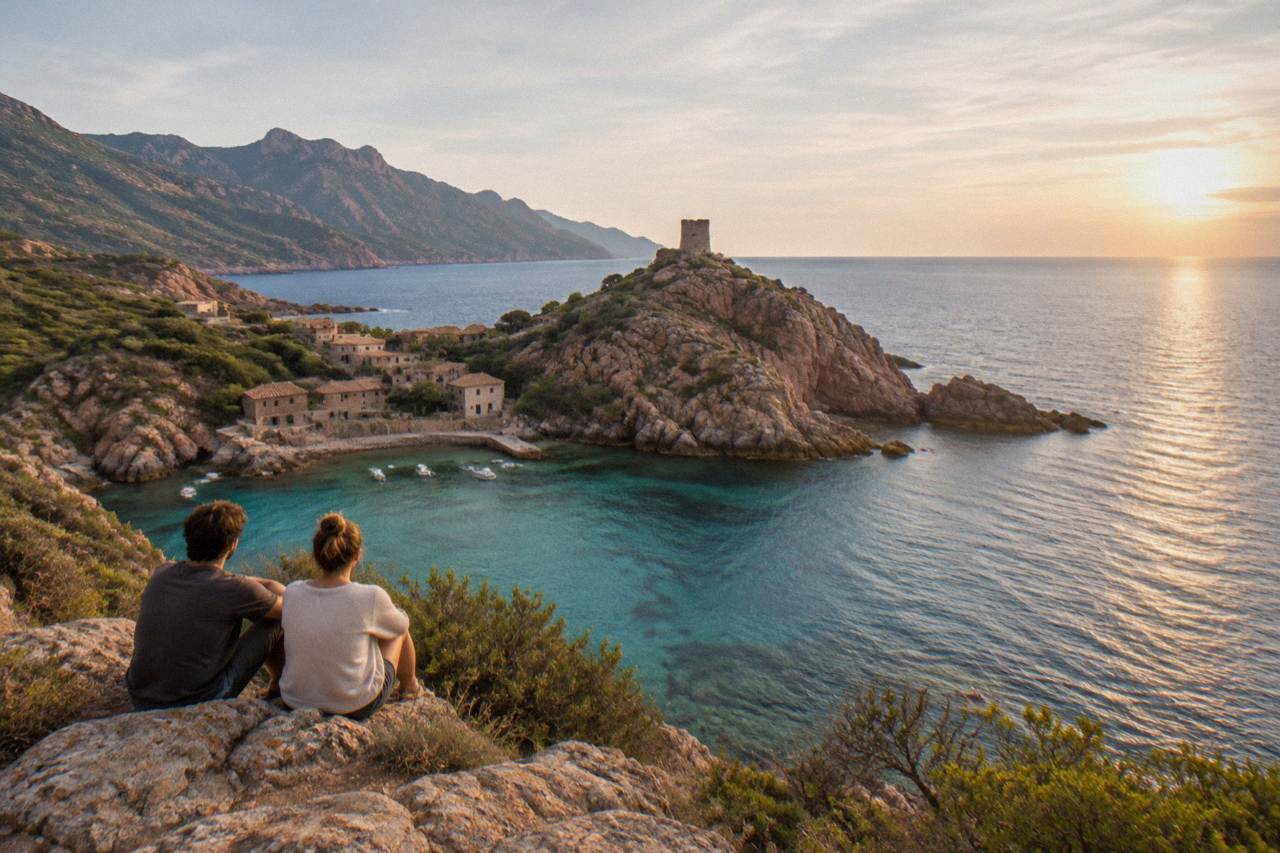
This page works through the practical questions: which bases suit a honeymoon, what the sea days cost and cover, what the mountains add, and what the food and drink scene actually holds.
Yes, for couples who want sea and mountain in one trip without changing countries. Corsica is a single French island of 8,722 km2 with more than 1,000 km of coastline and a mountainous interior that reaches 2,706 m at Monte Cinto, so a honeymoon here can hold beaches, boat trips, mountain villages and protected-label food inside one week or two. The mix, not any single sight, is the argument.
That mix has structure. The west coast carries the UNESCO property "Gulf of Porto: Calanche of Piana, Gulf of Girolata, Scandola Reserve", inscribed in 1983, which is visited by boat. The south holds Bonifacio's cliffs and the Îles Lavezzi inside the Bouches de Bonifacio Nature Reserve. The Balagne, around Calvi and L'Île-Rousse, strings beaches and hilltop villages together. Corte sits inland and was the island's old capital. A honeymoon can sample two or three of these without long transfers, since published road times to Corte run 1 hour from Bastia, 1 h 30 from Ajaccio and Calvi, 2 hours from Porto-Vecchio and 2 h 45 from Bonifacio or Propriano.
For a fuller run through the island's shape, see where Corsica is located and the overview of what Corsica is famous for.
Which Corsican Bases Work Best For A Honeymoon?
For a honeymoon of about a week, two bases cover the island well: one on the west or south coast for sea days, and one in the Balagne or around Ajaccio for beaches and town evenings. Bonifacio, Porto-Vecchio, Calvi, L'Île-Rousse and Ajaccio all sit directly on the water, and each anchors a different stretch of the more than 1,000 km coastline, while Corte adds a single inland interlude rather than a full stay.
Bonifacio pairs a clifftop citadel with boat trips to the Îles Lavezzi. The Escalier du Roi d'Aragon, 189 steps cut down the cliff, is the town's signature descent, and children even receive a small diploma at the top, reported by the Bonifacio reservation page, which also asks for closed-toe flat shoes. Porto-Vecchio anchors the southeast beaches, among them Palombaggia, Santa Giulia and Rondinara, each with its own guide page on this site. Calvi and L'Île-Rousse open the Balagne, where a coastal railway line links the two towns and the interior holds hilltop villages. Ajaccio, the capital and Napoleon's birthplace, carries Maison Bonaparte and the Palais Fesch, and it is the departure point for boat trips to the Îles Sanguinaires.
Corte, inland and the old capital, holds the citadel and the Musée de la Corse, where one ticket at EUR 5.50 covers both museum and citadel, with EUR 4 and EUR 3 reductions. The museum's own page gives the hours: daily 10:00 to 19:00 from 1 May to 31 October, and 10:00 to 17:00 in the low season except Sundays, Mondays, holidays and 24 December. For couples weighing the island against its neighbour, is Corsica better than Sardinia compares the two directly, and is Bonifacio worth visiting settles the south-coast question.
What Do The Sea Days Look Like From Each Base?
The sea day that defines a Corsica honeymoon is the boat cruise into Scandola, because the reserve's land area is closed to the public and visits run by boat only, reported by the Office de l'Environnement de la Corse. Cruises leave from Porto, Cargèse, Sagone, Ajaccio and even Calvi, so nearly every base on the island can reach the UNESCO property or the Calanques de Piana without repositioning.
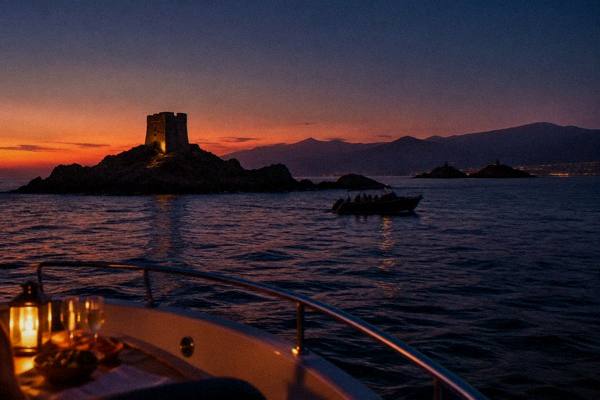
The reserve itself is precise: 919 ha of land, 1,000 ha of sea and a 70 ha integral reserve, created by ministerial order on 9 December 1975 as the first nature reserve in Corsica, and managed by the Parc naturel régional de Corse. Daytime anchoring is allowed outside the integral reserve and the Gargalu channel, with anchors lifted at sunset, and no recreational line or spear fishing is permitted. On the south coast, catamarans and cruises run from Bonifacio to the Îles Lavezzi, and from Porto-Vecchio the same islands are reached on full-day catamaran trips. Around Ajaccio, the Îles Sanguinaires carry sunset cruises with an aperitif on board, one of the easier romantic evenings to book on the island.
Among the west-coast options, the Scandola cruise with a swimming stop covers the reserve and the Calanches de Piana with time in the water, and Check availability for the date pair that suits, since sea trips depend on weather and swell. The sibling guide to the Scandola nature reserve explains the rules in full, and the page on whether Scandola is worth it addresses the value question head on.
What Does The Mountain Side Add To A Honeymoon?
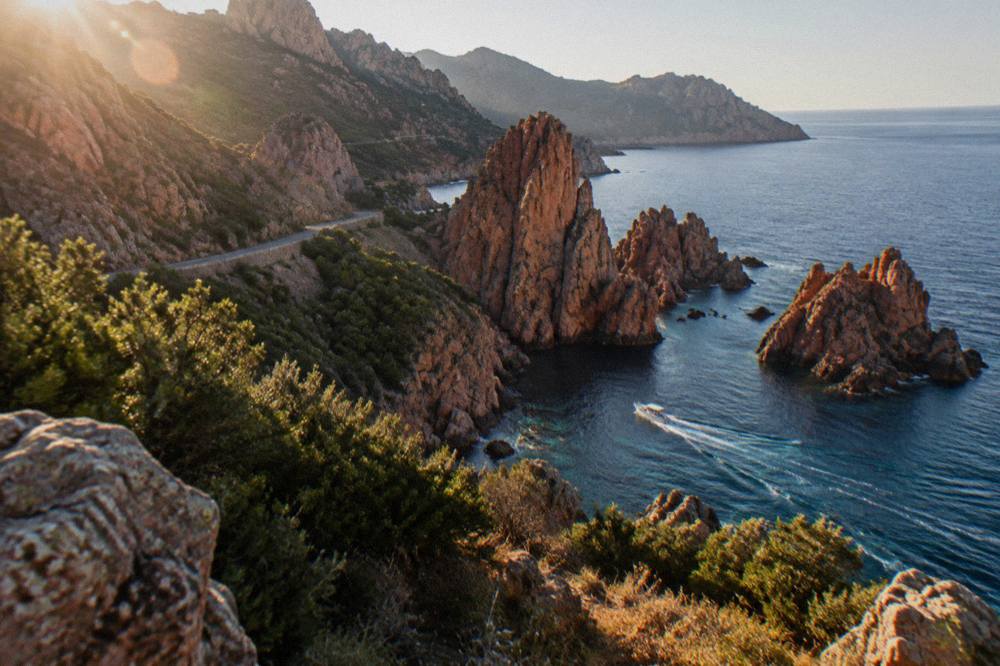
The interior adds a day or two of altitude and forest without demanding a full trek: the Gorges de la Restonica above Corte, the Aiguilles de Bavella in the far south and the Forêt d'Aïtone above Evisa are all reached by road, and the Parc naturel régional de Corse, created in 1972, now spans 4,484 km2 including valleys that run down to the sea. The GR20 crosses the same high country but is a project, not a day trip.
The GR20 runs 180 km north to south in about fifteen stages of 4 to 8.5 hours each, per the Corsican Assembly's own text, and its refuges were guarded from 16 May to 4 October in the 2026 season. Nights must be booked online, at EUR 20 per person for a refuge bunk, EUR 12 for a bivouac pitch with your own tent, EUR 27 for a one-person rented tent and EUR 39 for a two-person tent, the last two covering the pitch or pitches plus the tent. Dogs are not allowed in refuges or rented tents, no GR20 departures are allowed from Calenzana after 11:00 under a municipal order, and wild camping is banned across the island, with bivouacs tolerated only in the marked areas near refuges. For a honeymoon, the honest summary is that the GR20 is its own trip: is the GR20 hard and how long does the GR20 take size it up.
Softer mountain days exist. The Restonica valley climbs from Corte into high glacial lakes, the Bavella needles stand above the southern forests at Zonza, and the Spelunca gorge links Évisa and Porto on foot. Fire rules shape the summer: from 15 June to 30 September it is forbidden to light a fire or smoke in forests, maquis and massifs, and the access map for the massifs is updated at 18:00 each day for the next, so a mountain day in high summer deserves a check the evening before. The rest of the planning pages sit on Corsica Travel Guide.
What Should A Honeymoon Couple Eat And Drink In Corsica?
The table is built on protected labels, and they are the reason a Corsican dinner table can hold its own with anywhere in France: brocciu obtained its appellation d'origine in 1983, the charcuterie trio of prisuttu, lonzu and coppa took AOC in 2012 and AOP in 2014, olive oil carries the AOC "Huile d'olive de Corse, Oliu di Corsica" effective 2004, honey carries AOP "Miel de Corse, Mele di Corsica", and chestnut flour carries its own AOP, "Farina castagnina corsa".
The wine list runs through Patrimonio, Ajaccio, Muscat du Cap Corse and the Vin de Corse appellations with their named crus such as Calvi, Figari, Porto-Vecchio and Sartène, poured from the island's main red grapes, Nielluccio and Sciaccarellu, and its white Vermentinu, as the tourism board's gourmet pages describe. Dishes to look for by name include figatellu, the island's liver sausage, fiadone, a brocciu cheesecake, and canistrelli biscuits, and this site's pages on Corsican food and what to eat and Corsican wine carry the detail. A tasting in the Balagne or a food walk in Ajaccio slots easily into a honeymoon afternoon, and wine-tasting products around Calvi and Île-Rousse appear in the picks on this page.
| Product | Source | Year |
|---|---|---|
| Brocciu | Appellation d'origine | 1983 |
| Prisuttu, lonzu, coppa | AOC, then AOP | 2012, 2014 |
| Olive oil, Oliu di Corsica | AOC | Effective 2004 |
| Honey, Mele di Corsica | AOP | Recognised |
| Chestnut flour, Farina castagnina corsa | AOP | Recognised |
| Clémentine de Corse | IGP, then Label Rouge | 2007, 2014 |
What Will The Weather Do, Month By Month?
The Météo-France 1991-2020 station normals show why summer is the default honeymoon window: Ajaccio averages a July high of 28.6°C with 8.6 mm of rain and 12 h 6 min of sunshine a day, while November averages 111.8 mm of rain and only 4 h 42 min of sunshine, and Bastia's November figure runs higher still at 134.3 mm. October and November carry the most rain at both stations, and snow sits only on the high mountains.
The figures below are station normals, not forecasts, and the sea stays part of the picture deep into autumn: can you swim in Corsica in October takes that question on its own terms, and what is the best month to visit Corsica weighs the whole year.
| Month | Ajaccio High °C | Ajaccio Rain mm | Ajaccio Sunshine h/day | Bastia High °C | Bastia Rain mm |
|---|---|---|---|---|---|
| May | 22.1 | 49.8 | 9.3 | 22.4 | 53.7 |
| Jun | 25.9 | 25.9 | 11.1 | 26.4 | 38.8 |
| Jul | 28.6 | 8.6 | 12.1 | 29.4 | 13.8 |
| Aug | 29.2 | 15.8 | 11.1 | 29.8 | 21.1 |
| Sep | 26.1 | 57.8 | 8.7 | 26.0 | 74.5 |
| Oct | 22.8 | 85.7 | 6.7 | 22.0 | 126.5 |
| Nov | 18.3 | 111.8 | 4.7 | 17.7 | 134.3 |
Two safety notes sit beside the table. The UK FCDO notes a high risk of wildfires in France from April to October, which is the standing background to the summer access rules above, and the US State Department lists France at Level 2, Exercise Increased Caution, as reported on its own advisory page. On the water, Ajaccio ran seven lifeguard posts on its main beaches from 1 July to the end of August 2026, per the town's announcement, and Haute-Corse's supervised beaches are staffed by volunteer firefighters over roughly the same window, reported locally.
How Many Honeymoon Days Does Corsica Need?
A week gives a two-base honeymoon with two or three sea days, a mountain interlude and a town evening or two; ten days to a fortnight lets a third base in, and the island rewards it, since the driving times that matter, an hour from Bastia to Corte or 2 h 45 from Bonifacio, are short enough that the itinerary bends around what a couple wants rather than around the map.
The sister itineraries on this site, Corsica in 5 days, Corsica in one week and Corsica in 10 days, show the scaling directly, and how many days in Corsica is enough answers the question for every travel style. A honeymoon pair usually does better with two bases and slow days than with a nightly move, and the coastal railway between Calvi and L'Île-Rousse, part of the Chemins de fer de la Corse, adds a car-free afternoon in the Balagne. For arrival logistics, how do you get to Corsica covers ferries and the four airports, and do you need a car in Corsica settles the driving question.
| Sight | Full Price | Notes |
|---|---|---|
| Maison Bonaparte, Ajaccio | EUR 10 | Closed Monday; free for EU residents under 26 |
| Palais Fesch, Ajaccio | EUR 10 | EUR 6 over 65s, free up to 18; daily 09:00 to 17:00 |
| Musée de la Corse and citadel, Corte | EUR 5.50 | One ticket covers both; EUR 4 and EUR 3 reductions |
| Filitosa | EUR 9 | EUR 7 reduced; family ticket EUR 28; open 1 April to 2 November |
| Escalier du Roi d'Aragon, Bonifacio | Reported at about EUR 5 | 189 steps; closed-toe shoes required |
Common Questions About A Corsica Honeymoon
Is Corsica Good For A Honeymoon?
Yes, for couples who want sea and mountain in one trip: a French Mediterranean island with more than 1,000 km of coastline, a mountainous interior reaching 2,706 m at Monte Cinto, UNESCO-listed boat country on the west coast and a protected-label food and wine table.
Is Corsica Expensive For A Honeymoon?
Corsica is a euro-country island with mainland-French price levels on some items and local produce at market prices on others. Sight admissions are modest, from EUR 5.50 at the Musée de la Corse in Corte to EUR 10 at Maison Bonaparte and the Palais Fesch, and is Corsica expensive breaks the budget question down fully.
Which Side Of Corsica Is Better For Couples?
The west holds the UNESCO Gulf of Porto property and the Calanques de Piana, reached by boat; the south holds Bonifacio's cliffs, the Îles Lavezzi and the Porto-Vecchio beaches; the Balagne holds Calvi, L'Île-Rousse and the hilltop villages. Two bases, one coastal and one in the Balagne or around Ajaccio, cover all three temperaments.
Can You Honeymoon In Corsica Without A Car?
Partly: the Chemins de fer de la Corse links Ajaccio, Bastia and Corte on one line and Calvi with L'Île-Rousse on the Balagne coastal line, and boat trips leave on foot from the ports. But the beaches and mountain valleys are bus and taxi country, so a car widens the island a great deal, as do you need a car in Corsica explains.
What Is The Most Romantic Thing To Do In Corsica?
The sources point to the water: a sunset cruise to the Îles Sanguinaires from Ajaccio with an aperitif on board, or a swimming-stop cruise through Scandola and the Calanches de Piana on the west coast, where the reserve's land area is closed to the public and the sea is the only way in.
A Corsica honeymoon, in short, stands on solid ground: an island that fits in one travel day, a coast defined by boat-only reserves and clifftop towns, an interior measured in road hours rather than expedition days, and a table whose cheeses, charcuterie, oils, honeys and wines carry labels with dates attached. Plan two bases, book the sea days early, check the massif access map in high summer, and let the rest of the island follow.