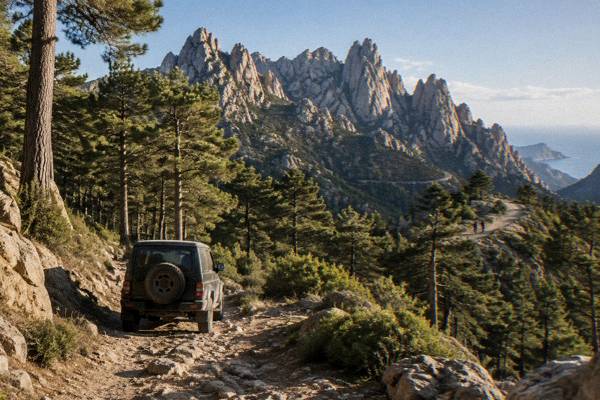
Is Corsica Good For Hiking?
Corsica is one of the finest walking islands in the Mediterranean, with the GR20, Mare a Mare and Mare e Monti trails, day walks and canyoning in a mountainous interior that rises to Monte Cinto at 2,706 m.
Corsica answers the hiking question with numbers before it answers it with adjectives. The island covers 8,722 km2, is the fourth-largest island in the Mediterranean, has more than 1,000 km of coastline, and yet its interior rises to Monte Cinto at 2,706 m, high enough to hold snow on the high mountains while the coast basks in a hot dry summer. The Parc naturel régional de Corse, created in 1972, spans 4,484 km2 and maintains a signed network that runs from the 180 km GR20 down to half-day gorge walks. The trail network offers a great deal, the rules are clear, and the timing of a visit matters.
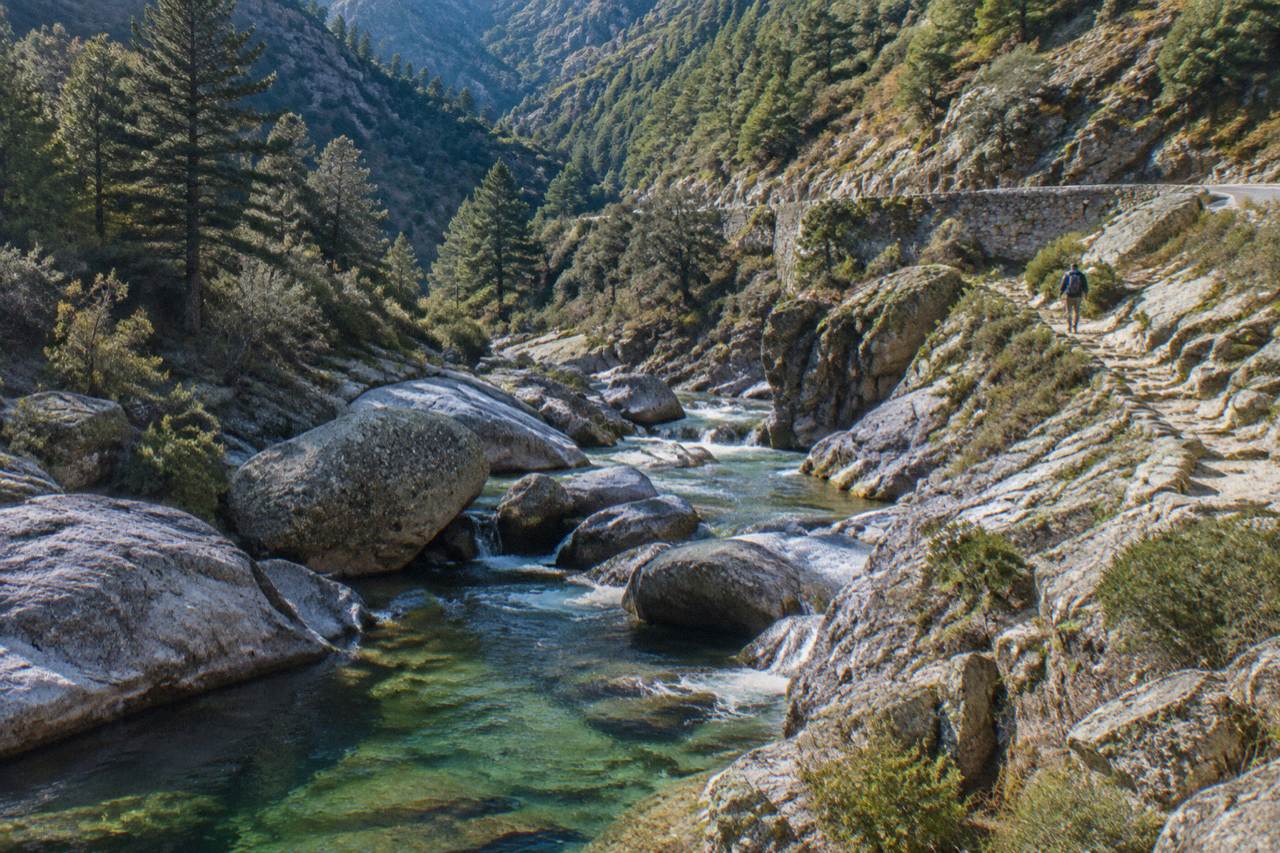
For a full survey of routes across the island, the companion guide to hiking in Corsica goes deeper, and the tours for hikers and active travellers covers guided options end to end.
Yes, and the trail network proves it with figures rather than marketing: Corsica carries the GR20, a 180 km mountain traverse walked in about 15 stages of 4 to 8.5 hours, plus five other signed long trails between 66 and 139 km, all inside a regional natural park of 4,484 km2 founded in 1972. Few Mediterranean islands pair granite summits above 2,700 m with a same-day return to the sea.
The Corsican Assembly's own description of the GR20 calls it a route of about fifteen stages over 180 km, north to south, with refuges and gites along the way. That route alone anchors the island's reputation among walkers. Around it sits a tiered system: the Mare a Mare routes cross the island coast to coast, the Mare e Monti routes hug the shoreline hills, and short valley walks serve anyone with a single free morning. The park's western sea front runs 80 km from Capu Rossu to Capu Cavallu, so even the coastal paths sit inside protected landscape rather than strip development.
Not everything is Alpine. The mix matters: a walker can spend one day on a granite ridge and the next on a coastal path, without leaving an island you can base in one or two towns for a week.
Which Long Trails Cross Corsica?
Six signed long routes cross or traverse Corsica: the GR20 at 180 km in about 15 stages, Mare e Monti Nord at 121 km over 10 days, Mare a Mare Nord at 139 km over 8 to 12 days, Mare a Mare Centre at 84 km over 7 days, Mare a Mare Sud at 73 km over 5 days and Mare e Monti Sud at 66 km over 5 days. The figures come from the PNRC's own trail brochure.
The variation is deliberate. The GR20 is the high mountain traverse, staged between guarded refuges. The Mare a Mare routes run coast to coast through the interior, with the Centre line linking Ghisonaccia to Porticcio and the Sud line ending in Propriano. The Mare e Monti routes stay closer to the sea, with the Nord route finishing at Cargèse after 6,100 m of cumulative climbing.
| Trail | Length | Days | Cumulative climb | End point |
|---|---|---|---|---|
| GR20 (Fra li Monti) | 180 km | about 15 stages | not stated in the PNRC material | north to south traverse |
| Mare e Monti Nord | 121 km | 10 | 6,100 m | Cargèse |
| Mare a Mare Nord | 139 km (161 km with variant) | 8 to 12 | 5,900 m | north coast |
| Mare a Mare Centre | 84 km | 7 | 3,900 m | Porticcio |
| Mare a Mare Sud | 73 km | 5 | 3,200 m | Propriano |
| Mare e Monti Sud | 66 km | 5 | 2,700 m | Propriano |
Stage days on the GR20 run 4 to 8.5 hours of walking, per the Assembly's text, which tells you the daily commitment honestly: some days are moderate, some are full mountain days. The Mare a Mare and Mare e Monti routes run shorter days on average, which makes them the natural choice for walkers who want a multi-day trip without the GR20's reputation.
If a full traverse sounds like too much, guided day options cover the same landscapes in smaller slices.
Is The GR20 As Hard As Its Reputation?
The GR20 is demanding and the numbers show it: 180 km in about 15 stages of 4 to 8.5 hours each, with the first stage alone, Calenzana to Ortu di u Piobbu, rated about 6 h 30 out, and a municipal order banning departures from Calenzana after 11:00 for safety reasons. The old Cirque de la Solitude section has been off the route since a fatal rockfall in 2015, replaced by a variant.
The refuge system makes the walk possible. In 2026 the PNRC refuges are guarded from 16 May to 4 October inclusive, and every night, whether a bunk or a bivouac pitch, must be booked online in advance. The 2026 rates are EUR 20 per person for a bunk, EUR 12 per person for a bivouac pitch with your own tent, EUR 27 for a one-person rented tent and EUR 39 for a two-person rented tent. Rental tents sleep two and come with a 3 cm mat per person, and you bring your own sleeping bag.
| PNRC option (2026 rates) | Price per person |
|---|---|
| Bunk in a guarded refuge (bat-flanc) | EUR 20 |
| Bivouac pitch, own tent | EUR 12 |
| Rented tent for 1 (pitch and tent) | EUR 27 |
| Rented tent for 2 (2 pitches and tent) | EUR 39 |
Dogs are not allowed inside refuges or rented tents. Wild camping is banned across Corsica, including on the GR20, with bivouac permitted only in the marked areas near the refuges, so the booking platform is not optional bureaucracy: it is the only legal way to sleep along the route. For anyone weighing the difficulty question honestly, the deeper discussion in is the GR20 hard? and the safety angle in is it safe to hike the GR20 alone? cover the ground stage by stage.
What Rules Should Hikers Know In Corsica?
Three rules shape every Corsican hiking plan: wild camping is banned island-wide and bivouac is allowed only at refuge areas, no fires or smoking are allowed in forests, maquis and massifs from 15 June to 30 September, and a daily fire-risk map, updated at 18:00 for the next day, can restrict access to some massifs from mid-June to mid-September. The rules are posted by the PNRC and enforced by prefectural order.
The fire rule is the one that catches out visitors most often, because it applies to the whole massif, not just campsites. In a hot dry summer, where July averages just 8.6 mm of rain at Ajaccio in the Météo-France 1991-2020 station normals, vegetation dries early and the prefecture reacts with access restrictions, occasionally closing whole massifs on the highest-risk days. Checking the daily map the evening before a walk is standard practice, and the GR20 departure limit at Calenzana exists for exactly this reason.
Emergencies have a clear structure. The European number 112 covers everything, 15 reaches medical services, 17 police, 18 fire, 114 works by SMS or app, and 196 is the sea rescue number. For mountain rescue, the PGHM base at Ajaccio answers on 04 95 24 24 00, though in a genuine emergency 112 or 17 is the call to make first.
When Is The Hiking Season In Corsica?
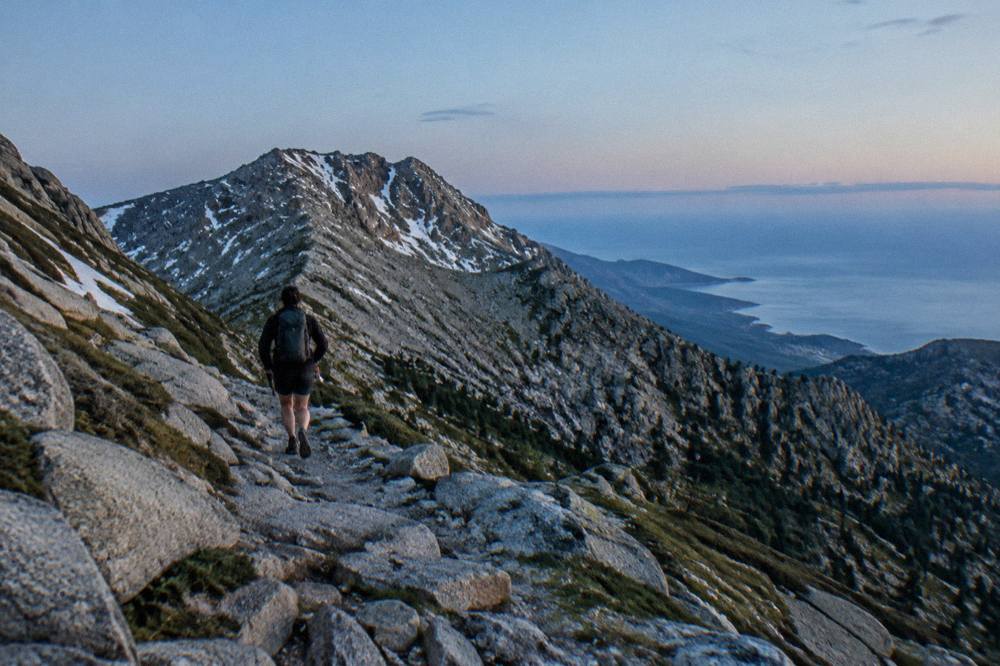
The guarded season runs 16 May to 4 October, and those dates are the practical answer: outside them the refuges are unguarded, inside them July averages only 8.6 mm of rain at Ajaccio but also a mean daily high of 28.6 °C, while November averages 111.8 mm of rain, so spring and early autumn carry the balance walkers usually want. The Météo-France station normals, 1991-2020, sit behind the figures.
| Month (Ajaccio station normals, 1991-2020) | Mean daily high | Rain mm | Refuge season |
|---|---|---|---|
| May | 22.1 °C | 49.8 | guarded from 16 May |
| June | 25.9 °C | 25.9 | guarded |
| July | 28.6 °C | 8.6 | guarded |
| August | 29.2 °C | 15.8 | guarded |
| September | 26.1 °C | 57.8 | guarded |
| October | 22.8 °C | 85.7 | guarded to 4 October |
Snow sits on the high mountains in winter, which is why the island's image as a summer beach destination coexists with genuine mountain conditions. October and November carry the most rain of the year at both Ajaccio, 85.7 and 111.8 mm, and Bastia, 126.5 and 134.3 mm, in the station normals. February has the lowest mean daily low at Ajaccio, 4.3 C. None of this stops winter walking on the coast, but it does close the high routes to all but equipped walkers.
The practical reading is straightforward. May, June and September fit the guarded refuge season with cooler daily highs and moderate rainfall. July and August suit walkers who accept heat on the ridges, and the fire map matters most then.
Do You Need To Walk For Days To Enjoy Corsica On Foot?
No: the island serves half-day and single-day walking just as well as traverses, with gorge routes such as the Restonica and Spelunca valleys, coastal paths around the Calanques de Piana, and guided day formats including canyoning in the Richiusa canyon near Bocognano, all reachable from towns like Ajaccio, Corte and Calvi without committing to a multi-day trek.
The Richiusa canyon tour is the clearest example of a day format with a mountain payoff: a guided descent near Bocognano, inland from Ajaccio, that needs no prior experience of the trail network and can be booked for a single date. The same logic applies to jeep-based days into the Asco valley from Calvi or the half-day trips through the Désert des Agriates from Saint-Florent, both of which put walkers into landscapes that would otherwise demand a full day of driving and route-finding.
For walkers who prefer to plan independently, the answers overview of whether Corsica is worth visiting and the piece on how many days in Corsica is enough help size a trip around the walking you actually want to do. The Corsica Travel Guide covers the bases, from Ajaccio to the Balagne, if the walking plan needs a town to anchor it.
Canyoning in particular deserves a place in a hiking week. It works the same granite and the same water as the footpaths, and Check availability for the Richiusa descent alongside any refuge bookings, since both fill early in the guarded season.
Common Questions About Hiking In Corsica
Is Corsica Good For Hiking?
Yes. The island has a 180 km high mountain traverse in the GR20, five further signed long trails between 66 and 139 km, and a regional natural park of 4,484 km2, all on an island with more than 1,000 km of coastline.
How Many Stages Does The GR20 Have?
About 15 stages, each of 4 to 8.5 hours of walking, over 180 km from north to south, according to the Corsican Assembly's own description of the route.
Do You Have To Book GR20 Refuges In Advance?
Yes. Nights in PNRC refuges must be booked online, for bunks and bivouac pitches alike. In 2026 a bunk costs EUR 20 per person and a bivouac pitch EUR 12, and the refuges are guarded from 16 May to 4 October.
Can You Wild Camp In Corsica?
No. Wild camping is banned across Corsica, including on the GR20. Bivouac is allowed only in the marked areas near PNRC refuges, with a reservation.
When Can Fires Or Smoking Be A Problem For Hikers?
From 15 June to 30 September it is forbidden to light a fire or smoke in forests, maquis and massifs, and from mid-June to mid-September a daily fire-risk map updated at 18:00 can restrict access to some massifs.
What Number Do You Call For Mountain Rescue In Corsica?
Call 112 or 17 in an emergency. The PGHM mountain rescue base at Ajaccio can be reached on 04 95 24 24 00.