Is Corsica Dog Friendly?
Is Corsica dog friendly? A clear answer on where dogs are banned on the island, the GR20 refuge rules, boats, beaches and fire-season limits, from the official sources.
Corsica, the French Mediterranean island of 8,722 km2 with more than 1,000 km of coastline, is a place built around beaches, coves, ports and a mountainous interior, and that mix shapes the answer for anyone travelling with a dog. The island's rules come from named authorities: the Parc naturel régional de Corse for the GR20 and its refuges, the Office de l'Environnement de la Corse for the Scandola Reserve, and the prefectures for the summer fire-risk map. Dogs are welcome in much of day-to-day island life, but there are hard bans in the high mountains and on protected reserve land, and the fire season from mid-June to the end of September adds daily access limits that apply to walkers with or without a dog. This page sets out what each of those sources actually says, question by question, so a dog owner can plan around the real rules rather than guesswork.
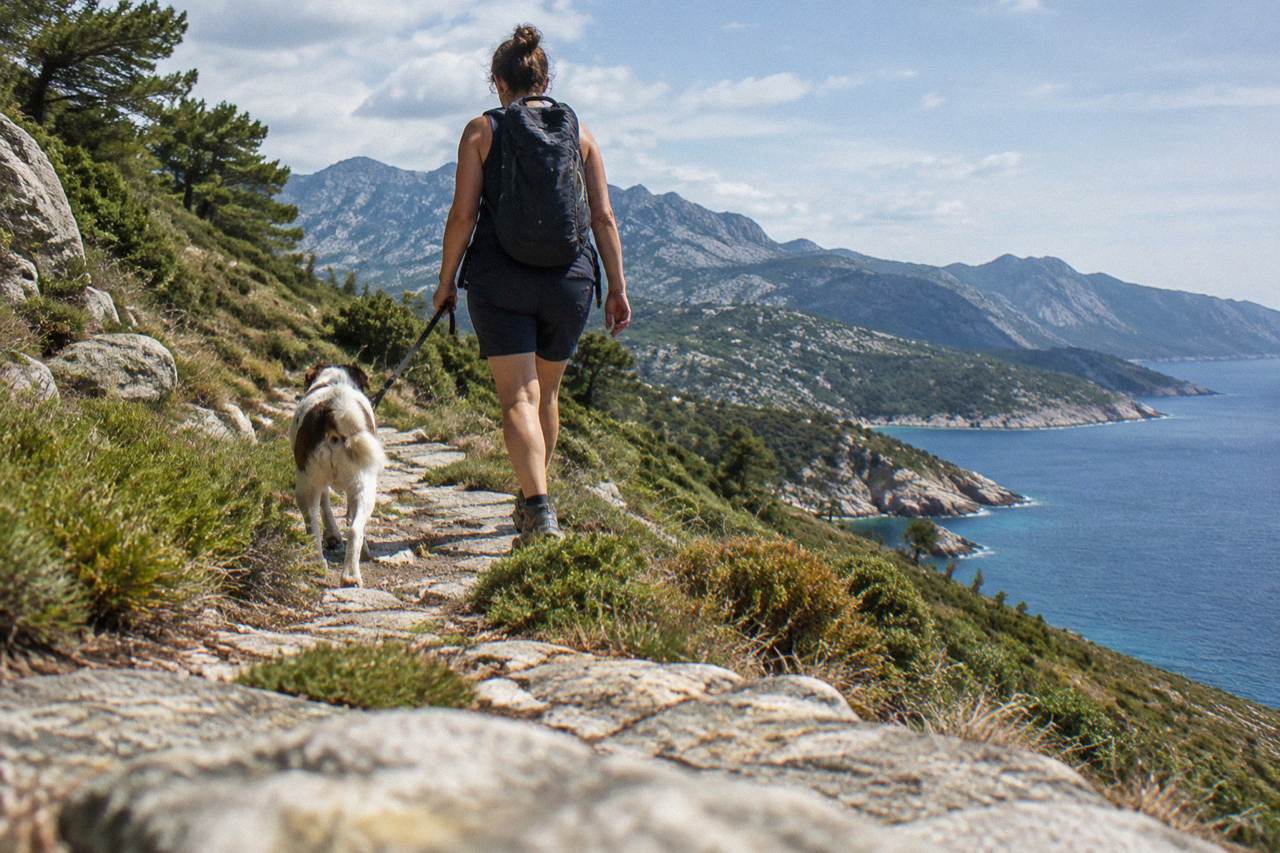
Yes, in most everyday settings, with two clear exceptions: the PNRC states that dogs are not allowed inside GR20 refuges or in rented tents, and the Scandola Reserve's land area is closed to the public altogether, so no dog and no owner may set foot there. Beyond those bans, the island's trails, beaches, ports and villages are generally open to dogs, and boat operators run trips where a leashed dog is a normal sight.
The word "generally" is doing honest work there, because Corsica's dog rules are set place by place rather than island-wide. The 1972 Parc naturel régional de Corse covers 4,484 km2, and inside it the park authority's word is final on refuges and bivouac areas. On the coast, the Bouches de Bonifacio Nature Reserve and the Scandola Reserve each have their own access rules. Beaches in towns such as Ajaccio, the capital with 76,320 residents, or Bastia, with 46,867, are run by the municipalities, and supervision is a summer affair: Ajaccio operated seven lifeguard posts on its main beaches from 1 July to the end of August 2026, and Haute-Corse's supervised beaches are staffed by volunteer firefighters roughly 1 July to 31 August. A dog owner's planning question is therefore not "is the island dog friendly" but "which of these zones am I in today".
For context on the island itself, see where Corsica is located and what Corsica is famous for.
Where Are Dogs Banned In Corsica?
The two firm bans the official pages state are these: dogs are not allowed inside PNRC refuges or in the rented tents on the GR20, per the park's own GR20 page, and the terrestrial part of the Scandola Reserve is closed to the public entirely, with visits by boat only and no landing in the integral reserve, so dogs are excluded along with everyone else.
Wild camping is banned across Corsica, including the GR20, with bivouac allowed only in the marked areas near refuges, and those refuge areas are where the dog ban bites. No such prohibition extends to beaches, villages or ordinary trails.
The GR20 rule deserves emphasis because it is the one that catches people out. The trail runs 180 km north to south in about 15 stages of 4 to 8.5 hours, and anyone walking it needs a booked bunk or bivouac pitch each night, reserved online only, for the 2026 guarded season of 16 May to 4 October. A dog cannot sleep in those refuges or tents, which in practice rules out a through-hike with a dog. There is also a fire-safety order at the northern end: no GR20 departures from Calenzana after 11:00.
Scandola is the other absolute one. The reserve, created by ministerial order on 9 December 1975, covers 919 ha of land, 1,000 ha of sea and a 70 ha integral reserve, and sits inside the UNESCO property "Gulf of Porto: Calanche of Piana, Gulf of Girolata, Scandola Reserve", inscribed in 1983. The Office de l'Environnement de la Corse states the land is closed to the public, anchoring is daytime only outside the integral reserve, and recreational line and spear fishing is prohibited. A dog stays on the boat, and so does its owner for the land part.
Can You Take A Dog On A Boat Trip In Corsica?
Yes, and in some cases the boat is not a workaround but the only legal access: the OEC page states visits to Scandola are by boat only. Beyond Scandola, cruises run from Bonifacio to the Îles Lavezzi, from Ajaccio to the Îles Sanguinaires, and catamarans from L'Île-Rousse work the Désert des Agriates coast, so operators' pet terms vary, so confirm before booking.
Operators' pet terms vary, so confirm before booking.
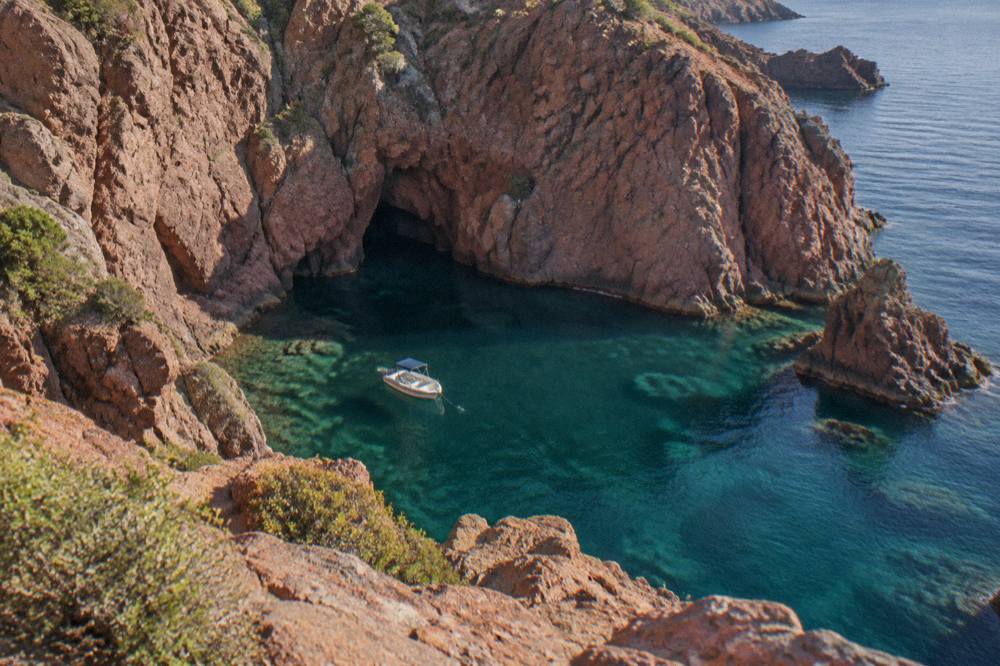
Beyond Scandola, the sea opens the rest of the coast. From Bonifacio, cruises run to the cliffs and the Îles Lavezzi inside the Bouches de Bonifacio Nature Reserve. From Ajaccio, gulf tours reach the Îles Sanguinaires. From L'Île-Rousse, catamarans work the Désert des Agriates coast, where the beaches of Saleccia and Lotu are otherwise reached by boat shuttle from Saint-Florent, by 4x4 track from Casta, or on foot. A dog that is steady on a boat therefore gets the island's best scenery with none of the land-access conflicts.
Can You Hike The GR20 With A Dog In Corsica?
Not as a through-hike: the PNRC's own GR20 page bans dogs from refuges and rented tents, and every night on the 180 km, roughly 15-stage trail requires a reserved bunk or bivouac pitch online, so a dog has nowhere legal to sleep along the route; the same page sets the 2026 guarded season at 16 May to 4 October, forbids wild camping across the island, and bars departures from Calenzana after 11:00 under a municipal fire-risk order. Day walks on sections that do not end at a refuge night are a different question, and the fire-risk map still applies.
The booking system is strict, and it is worth understanding before any plan involving the high mountains. Reservations are obligatory for every option, handled exclusively online with card payment, changes are possible up to 48 hours before a stage subject to availability, and a full refund is available up to two months ahead. Quotas per refuge apply and the confirmation email is the receipt. The 2026 price ladder is in the table below. The full index of guides sits on Corsica Travel Guide.
| GR20 overnight option (PNRC 2026) | Price per person | Dog allowed |
|---|---|---|
| Refuge bunk (bat-flanc) | EUR 20 | No |
| Bivouac pitch, own tent | EUR 12 | No (rented tents); pitch rules per refuge |
| Rented tent, one person (pitch and tent) | EUR 27 | No |
| Rented tent, two people (two pitches and tent) | EUR 39 | No |
For a dog owner who still wants mountain days, the island's other long trails avoid the refuge system's dog ban, since they are lower, village-to-village routes. The PNRC brochure gives their lengths and climbing totals directly:
| Trail (PNRC) | Length | Days | Total climb |
|---|---|---|---|
| Mare e Monti Nord | 121 km | 10 | 6,100 m |
| Mare a Mare Nord | 139 km (161 km with variant) | 8 to 12 | 5,900 m |
| Mare a Mare Centre (Ghisonaccia to Porticcio) | 84 km | 7 | 3,900 m |
| Mare a Mare Sud | 73 km | 5 | 3,200 m |
| Mare e Monti Sud | 66 km | 5 | 2,700 m |
On whether a car is the better base for this kind of trip, do you need a car in Corsica covers the trade-offs, and the general hiking in Corsica guide maps the walking regions.
What Do The Summer Fire Rules Mean For Dog Walkers In Corsica?
From 15 June to 30 September it is forbidden to light a fire or smoke in Corsica's forests, maquis and massifs, and from mid-June to mid-September access to some massifs can be restricted outright on high-risk days, with the prefecture-linked map updated at 18:00 each evening for the next day; these rules apply to every walker, and the UK FCDO notes a high risk of wildfires in France from April to October. A dog walker's takeaway is to check the day's colour level before any forest or massif route in summer.
This is not background noise: the ban sits on the PNRC's own GR20 page and is repeated in prefectural orders. Some massifs can close fully on the severest days, with access, circulation and parking banned on affected trails and tracks. The practical habit is simple. In summer, look at the map in the evening, then choose between a coastal walk and a massif walk accordingly. Coastlines such as the 80 km stretch of the regional park's western sea front, from Capu Rossu to Capu Cavallu, stay outside the forest-access system.
Emergency numbers are worth having saved whatever the season: 112 for the EU-wide emergency line, 15 for medical, 17 for police, 18 for fire, 114 by SMS or app for deaf or speech-impaired callers, and 196 for sea rescue on VHF channel 16. Mountain rescue is the PGHM in Ajaccio on 04 95 24 24 00, with 17 or 112 in an emergency.
How Do You Travel To And Around Corsica With A Dog?
Ferries are the pet-friendly route in: Corsica Linea sails Marseille to L'Île-Rousse, Bastia, Propriano and Ajaccio, La Méridionale sails Marseille to Ajaccio and Porto-Vecchio, Moby sails Livorno, Genoa and Santa Teresa Gallura to Bastia and Bonifacio, and Corsica Ferries runs from Toulon, Nice, Livorno and Savona, per the operators' own sites; each operator sets its own pet terms and kennel arrangements, and there are four airports, Ajaccio (AJA), Bastia (BIA), Figari (FSC) and Calvi (CLY), for flyers. More than 8.5 million passengers passed through Corsica's ports and airports in 2025, excluding cruise passengers.
The crossing lengths are worth knowing when a dog is aboard. Reported ranges put Santa Teresa Gallura to Bonifacio at about 50 to 60 minutes, Livorno to Bastia at about 4 to 5 hours, Savona to Bastia at about 6.5 hours, Nice to Bastia at about 7.5 to 10 hours, Toulon routes at about 10 to 13 hours and Marseille routes at about 12 to 13 hours, mostly overnight. Onboard, the Chemins de fer de la Corse run the Ajaccio to Bastia line via Corte, the Ponte-Leccia to Calvi line and the Balagne coastal line between Calvi and L'Île-Rousse, and each carrier's pet policy is its own.
For money questions, is Corsica expensive covers the budget picture, and is Corsica worth visiting frames the island's draw. More on the crossing itself is in how do you get to Corsica.
Which Sights And Towns Work With A Dog In Corsica?
The outdoor sights are the dog-friendly tier: the Désert des Agriates, the coastal paths, the villages of the interior and the viewpoints around the Aiguilles de Bavella and the Gorges de la Restonica involve no stated dog ban, while the indoor museums set their own rules and the island's paid heritage sites mostly consist of open air; the one sight with a confirmed dog rule is the GR20's refuge network, and the one sight with a blanket access rule is Scandola, closed on land to everyone. Filitosa, the prehistoric site open 1 April to 2 November from 09:00, is an open-air stop where a leashed dog is a reasonable ask of the desk.
Towns are straightforward. Ajaccio holds Maison Bonaparte on Rue Saint-Charles, 200 m from the bus station and ferry terminal, open every day except Monday, though as a national museum its interior rules are its own. Bastia's old harbor is the departure point for sea trips along Cap Corse and the Agriates. Cargèse and Sagone serve the Scandola boat circuit from the south, and Porto-Vecchio's old town and Bonifacio's cliff-top paths are walkable streets rather than gated sites. Inforoutes Corse publishes live road conditions and pass accessibility, useful when storm debris affects the mountain roads at any time of year.
Common Questions About Corsica With A Dog
Is Corsica Dog Friendly?
Yes in most everyday settings, with two firm exceptions: the PNRC bans dogs from GR20 refuges and rented tents, and Scandola's land area is closed to the public entirely. Beaches, villages, ordinary trails and boat decks are otherwise open to dogs, subject to each operator's or municipality's own rules.
Can A Dog Stay In A GR20 Refuge?
No. The PNRC GR20 page states dogs are not allowed inside refuges or rented tents, and every overnight stay on the trail must be reserved online, so there is no unbooked alternative for a dog.
Can A Dog Go To Scandola?
Not onto the land. The reserve's terrestrial part is closed to the public and visits are by boat only, so a dog can ride along on an authorised boat trip but cannot land.
Are Dogs Allowed On Corsican Beaches?
There is no island-wide ban in the official rules; beaches are managed locally, and supervised zones operate in summer, with Ajaccio running seven lifeguard posts from 1 July to the end of August 2026 and Haute-Corse beaches supervised roughly 1 July to 31 August. Check the local commune's signs.
Can You Camp In Corsica With A Dog?
Wild camping is banned across Corsica, including the GR20, with bivouac allowed only in the marked areas near PNRC refuges, and those refuge areas exclude dogs. Formal campsites set their own pet policies.
A dog that travels well, stays on a lead and handles a boat will find Corsica workable: the sea routes cover what the land rules close, and the fire-season map tells a walker which half of the island is open on any given summer day.