Is Corsica Good For Families With Kids?
Corsica works well for families: short drives, lifeguarded beaches, boat trips, and museums that are free or cheap for children. What the sources say, and what to plan around.
Yes, and the reasons are unusually concrete. Corsica is a French Mediterranean island of 8,722 km2 with more than 1,000 km of coastline, which means the sea is always close, and its mountainous interior, topping out at Monte Cinto at 2,706 m, sits within a couple of hours' drive of every coastal base. Beaches are supervised in summer, museums are free or cheap for children, and the boat trips that dominate the island's visitor offer are short enough for kids. The trade-offs are real too: from 15 June to 30 September fires and smoking are banned in forests, maquis and massifs, some massifs close entirely on high-risk days, and July and August are hot, with average daily highs of 28.6 °C at Ajaccio in the Météo-France 1991-2020 station normals. What the sources actually say about families on the island, from lifeguard dates to child ticket prices, appears below, along with the itineraries and tours that fit best. Corsica Travel Guide is based on what primary sources publish, and nothing in it rests on a personal trip.
Corsica is a good family destination, on the strength of three verifiable things: supervised swimming in summer, with seven lifeguard posts on Ajaccio's main beaches from 1 July to the end of August; short travel distances, since Corte is 1 h 30 by road from both Ajaccio and Calvi; and generous child pricing, with free entry up to 18 at the Palais Fesch and free under-6 entry at Filitosa.
The main planning constraint is the summer fire regime, which bans fires and smoking in the massifs from 15 June to 30 September and can close trail access on red-risk days.
The swimming supervision picture is documented. The town of Ajaccio ran 7 lifeguard posts from 1 July to the end of August 2026 on its main beaches, and in Haute-Corse, supervised beaches are staffed by volunteer firefighters roughly 1 July to 31 August. Before and after those windows, swimming is unsupervised, so families travelling in June or September should treat beach days differently.
Distances keep car time short. The Musée de la Corse's own practical page lists road times to Corte of 1 hour from Bastia, 1 h 30 from Ajaccio, 1 h 30 from Calvi, 2 hours from Porto-Vecchio and 2 h 45 from Bonifacio. That is the scale of the island: one or two hours of driving connects almost any base to a completely different landscape, which is the single biggest practical advantage for parents.
Which Corsica Sights Cost Little Or Nothing For Children?
Several major Corsican sights are free for young visitors: the Palais Fesch in Ajaccio is free up to 18, Maison Bonaparte is free for EU residents under 26, and the Musée de la Corse in Corte is free for under-10s, while Filitosa charges EUR 7 for ages 6 to 17 and EUR 28 for a family of two adults and two children. The A Cupulatta turtle park, a skip-the-line ticket, is one of the cheapest paid outings on the island. Those prices come from each site's own published rates.
The pattern holds across the island's main family-friendly sights, and the table below gathers the published figures in one place.
| Sight | Location | Full price | Child / family rate | Opening notes |
|---|---|---|---|---|
| Palais Fesch | Ajaccio | EUR 10 | EUR 6 over 65s, free up to 18 | Daily 09:00 to 17:00 |
| Maison Bonaparte | Ajaccio | EUR 10 | EUR 8 non-EU 18-25 and large families, free for EU under-26 | Closed Monday |
| Musée de la Corse and citadel | Corte | EUR 5.50 | EUR 3 to 4 reduced, free under-10s | One ticket covers museum and citadel |
| Filitosa | Sollacaro | EUR 9 adults | EUR 7 ages 6-17, family EUR 28, free under 6 | Open 1 April to 2 November |
| Escalier du Roi d'Aragon | Bonifacio | About EUR 5 | EUR 2 for ages 6-11 | 189 steps, closed-toe shoes required |
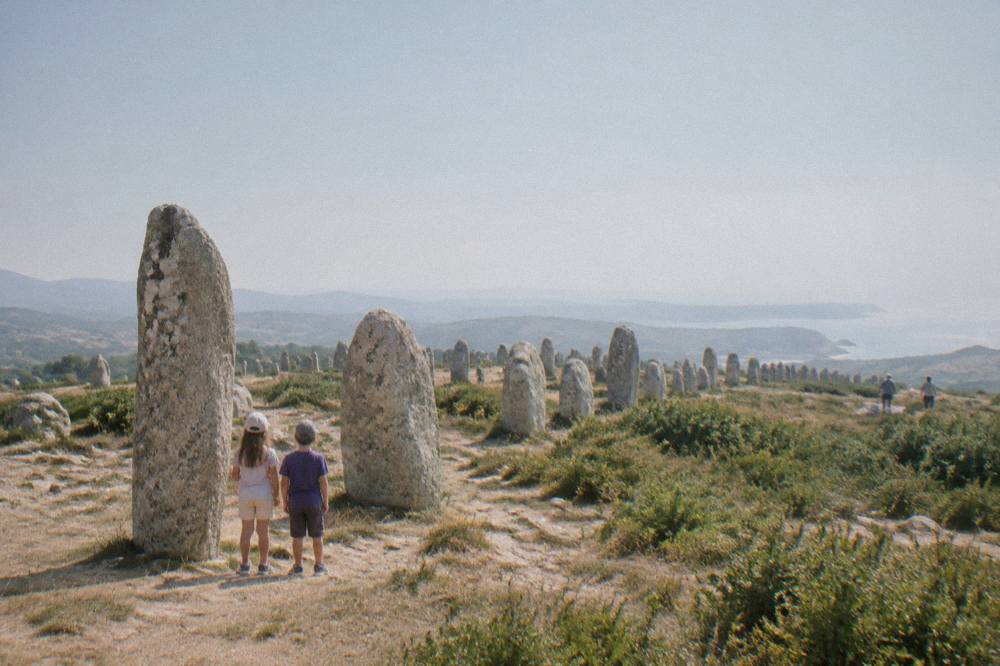
A few of these deserve a note. Filitosa's open-air menhir field doubles as a run-around space, and the site's own page suggests allowing about 1 h 30, which suits school-age children better than toddlers. The Escalier du Roi d'Aragon is 189 steps cut into the Bonifacio cliff, with a 180-degree view over the strait towards Sardinia, and children get a small "diploma" at the top, but the site requires closed-toe flat shoes. Maison Bonaparte sits on Rue Saint-Charles in Ajaccio, 200 m from the bus station and ferry terminal, with bus 8 from the airport, which makes it one of the easiest sights to reach without a car.
Are Corsica Boat Trips Suitable For Children?
Many are, and boat trips are the island's core family activity because they turn the hardest-to-reach scenery into a seated outing: the Scandola reserve can only be visited by boat, its land area being closed to the public, and short cruises from Porto, Calvi, Ajaccio, Bonifacio and L'Île-Rousse cover grottoes, red cliffs and swimming stops without a long hike. Durations range from about 90 minutes upward, so families can match a trip to their children's attention span.
The flagship option is the Scandola reserve, part of the UNESCO property "Gulf of Porto: Calanche of Piana, Gulf of Girolata, Scandola Reserve", inscribed in 1983. The reserve was the first created in Corsica, by ministerial order of 9 December 1975, and covers 1,000 ha of sea and 919 ha of land. Visits are by boat only, with no landing in the 70 ha integral reserve, which is exactly why a cruise works so well for children: the entire visit happens from the deck.
Check availability if it fits your dates.
| Family need | Good fit | Why it works |
|---|---|---|
| Short first boat trip | Piana Calanques and Caves by Boat (1.5 hours) | Grottoes and cliffs with a quick return to shore |
| Swimming stop | Scandola cruise with swimming stop (3 h 15) | Combines sightseeing with a swim break |
| Beaches without a long drive | Agriate jeep tour to Lotu and Saleccia from Calvi | Reaches the Désert des Agriates beaches by jeep |
| Easy wildlife day | A Cupulatta turtle park skip-the-line | Short visit, cheap ticket, no boat needed |
| History without walking far | Ajaccio open-top bus tour with audio guide | Seated city overview with 360-degree views |
Is Corsica Safe For Families?
On the documented record, yes: emergency numbers are standard European ones, 112 for all emergencies plus 15, 17, 18, 114 and 196 for sea rescue, and mountain rescue is reachable through the PGHM Ajaccio on 04 95 24 24 00; the UK FCDO notes a high wildfire risk in France from April to October, and the US State Department lists France at Level 2, Exercise Increased Caution.
The island's specific family risks are heat, water and fire-season access rules, all of which are published and easy to plan around.
The fire regime is the one genuinely Corsican rule set. From 15 June to 30 September it is forbidden to light a fire or smoke in forests, maquis and massifs. The fire-risk map is updated at 18:00 for the next day, and from mid-June to mid-September access to some massifs can be restricted or closed entirely on the highest-risk days, so a family hike plan should always be checked the evening before. On the GR20 specifically, no departures are allowed from Calenzana after 11:00 under a municipal order tied to fire risk. Other pages covering the same trip are gathered on Corsica Travel Guide.
Water safety is supervised in July and August, as covered above, and the 196 sea-rescue number applies at sea. For a wider view of the island's safety picture, read is Corsica safe for tourists.
How Hot Is Corsica In Summer, And Does That Matter For Kids?
July and August average daily highs of 28.6 °C and 29.2 °C at Ajaccio and 29.4 °C and 29.8 °C at Bastia in the Météo-France 1991-2020 station normals, with July the lowest-rain month at 8.6 mm in Ajaccio and 13.8 mm in Bastia; rain rises through autumn, with November averaging 111.8 mm at Ajaccio and 134.3 mm at Bastia. For families this means beach mornings and shaded afternoons in midsummer, and reliably warm, drier conditions from June.
| Month | Ajaccio high / low (°C) | Ajaccio rain (mm) | Bastia high / low (°C) | Bastia rain (mm) |
|---|---|---|---|---|
| June | 25.9 / 15.4 | 25.9 | 26.4 / 16.5 | 38.8 |
| July | 28.6 / 17.7 | 8.6 | 29.4 / 19.4 | 13.8 |
| August | 29.2 / 18.1 | 15.8 | 29.8 / 19.8 | 21.1 |
| September | 26.1 / 15.4 | 57.8 | 26.0 / 16.7 | 74.5 |
| October | 22.8 / 12.6 | 85.7 | 22.0 / 13.4 | 126.5 |
The Météo-France normals also show sunshine averaging 12.1 hours per day in July at Ajaccio, which is a lot of exposure for small children: sun cream, hats and a midday break stop being optional in those months. September stays warm, 26.1 °C average highs at Ajaccio, with the first lifeguard-free beaches, so competent-swimmer families often prefer it. The site's month-by-month breakdown at best time to visit Corsica goes deeper, and does it rain a lot in Corsica covers the wet season.
Do You Need A Car For A Family Trip To Corsica?
For most families, yes: the island's train network, the Chemins de fer de la Corse, runs only three lines (Ajaccio to Bastia via Corte, Ponte-Leccia to Calvi, and the Balagne coastal line Calvi to L'Île-Rousse), and the beaches and trailheads that make Corsica special mostly sit beyond it, so a car is the normal family tool; car-free bases such as Ajaccio and Calvi can still fill a shorter stay using buses, boats and trains.
The practical middle path is to pick one base with boat and train access and stay put. Ajaccio has bus 8 from the airport into town and boat trips to the Îles Sanguinaires; Calvi and L'Île-Rousse are joined by the coastal Balagne line, which is itself a family outing. For the trade-offs in full, including the ferry-and-fly arrival options, see do you need a car in Corsica and how do you get to Corsica.
One animal-related note for families deciding on activities: dogs are not allowed inside the PNRC refuges or rented tents on the GR20, so the long hikes are not a bring-the-dog proposition. Families with school-age children curious about the famous trail should start with is the GR20 hard rather than a stage plan.
Common Questions About Corsica With Kids
Is Corsica Good For Families With Kids?
Yes. Supervised beaches in July and August, short driving distances between coast and mountains, free or cheap museum entry for children, and boat trips that suit all ages make it a strong family island. Plan around the 15 June to 30 September fire rules and midsummer heat.
Are Corsican Beaches Supervised For Swimming?
In the core summer window, yes: Ajaccio operated 7 lifeguard posts from 1 July to the end of August 2026, and Haute-Corse beaches are supervised by volunteer firefighters roughly 1 July to 31 August. Outside that window swimming is unsupervised.
Which Corsican Museums Are Free For Children?
The Palais Fesch in Ajaccio is free up to 18, Maison Bonaparte is free for EU residents under 26, and the Musée de la Corse in Corte is free for under-10s. Filitosa charges EUR 7 for ages 6 to 17 with a EUR 28 family ticket.
Can Children Visit The Scandola Reserve?
Yes, by boat. Scandola's land area is closed to the public and visits are by boat only, so children see the reserve from the deck. Cruises from Porto run around three hours, and the whole UNESCO property was inscribed in 1983.
Is July Too Hot For Children In Corsica?
July averages 28.6 °C daily highs at Ajaccio and 29.4 °C at Bastia in the Météo-France 1991-2020 normals, with 12.1 hours of daily sunshine at Ajaccio. Beach mornings, shade at midday and plenty of water are the standard adjustments.
Families who match their dates to the lifeguard season, keep museum mornings for the hours and boat trips for the afternoons, and check the fire-risk map before any mountain day will find Corsica one of the more manageable islands in the Mediterranean for travelling with children.