Do They Speak English In Corsica?
English in Corsica: where visitors meet English speakers, what the Corsican language is, and how tours, museums and restaurants handle English on the island.
Corsica is a French island in the Mediterranean with more than 1,000 km of coastline, and French is the language of daily life across its 360 communes, from Ajaccio, the capital and birthplace of Napoleon, to Bastia, the second town with 46,867 residents. English is not an official presence in the island's administration, but it travels well through the parts of Corsica that visitors actually use: the ferry ports, the cruise stops, the boat trips and the museum counters. More than 8.5 million passengers passed through Corsica's ports and airports in 2025, per the ORTC and DREAL de Corse annual report, and an economy moving that many people runs partly on English at the counter even when the street outside runs on French. Where English works, where French and Corsican dominate, and what a monolingual English speaker can sensibly plan for all become clear here.
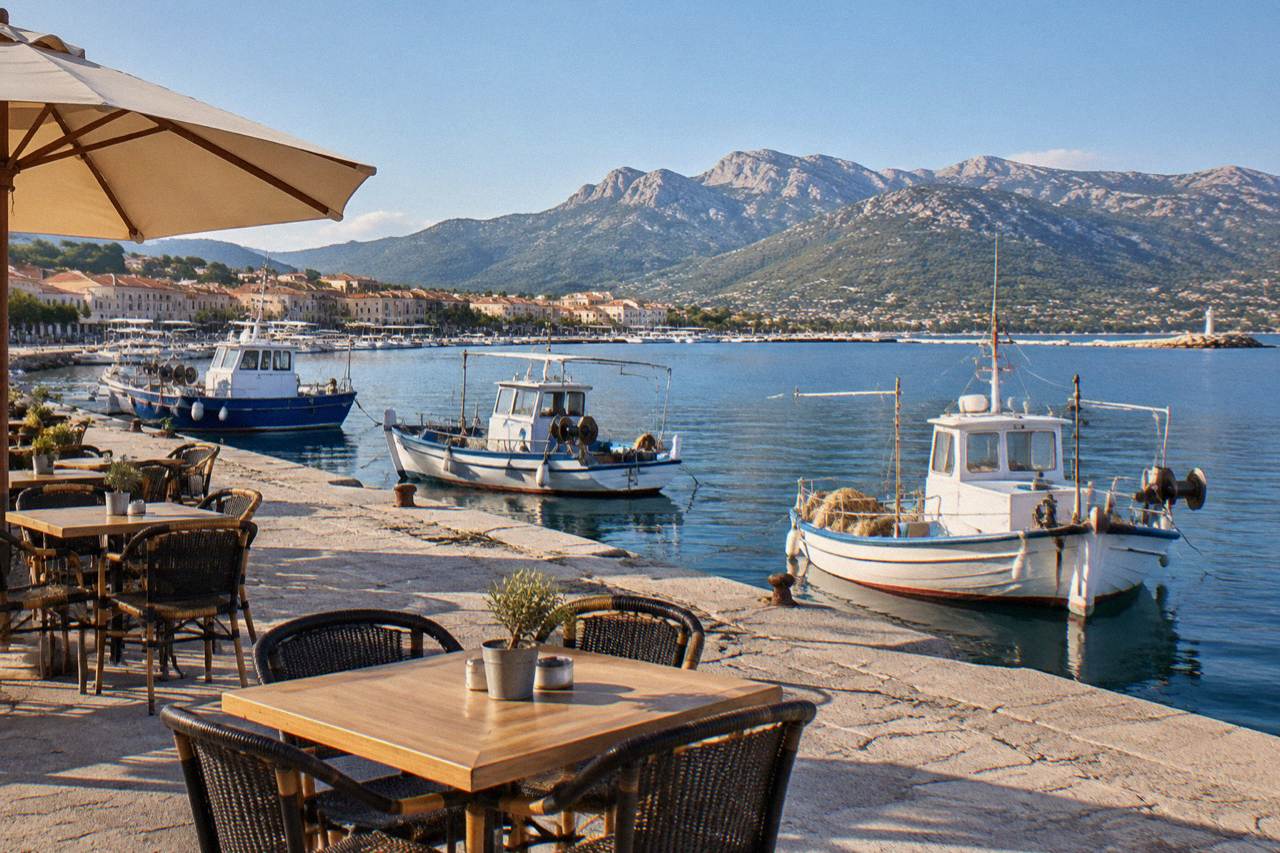
Yes, English is spoken in Corsica, mainly in the visitor economy rather than in daily administration: hotel desks, boat tour operators, museums with international audiences and the larger restaurants in Ajaccio, Bonifacio, Porto-Vecchio, Calvi and Bastia generally have staff who can serve guests in English. French remains the island's working language everywhere else, including shops, markets, taxi ranks and public offices, so a few French phrases go further than expecting English at every turn.
The pattern follows the geography of the island's tourism. Ajaccio, with 76,320 residents, and Bastia are working French towns that also handle cruise and ferry traffic, so their waterfront businesses are the places where English is most routine. Bonifacio and Porto-Vecchio, in Corse-du-Sud, live heavily off visitors arriving by ferry from Santa Teresa Gallura and by road from Figari Sud Corse airport, and their tour desks and restaurants deal with international guests throughout the season. Inland, in Corte and the mountain villages, French, and often Corsican, carry the conversation.
The museums illustrate the split clearly. The national museum at Maison Bonaparte in Ajaccio publishes its practical information in English on its own site, including its hours, which run 10:00 to 17:30 continuously from 1 July to 30 September. The Musée de la Corse in Corte provides an English page for its practical details. Smaller municipal sites, and plenty of village cafés, publish nothing but French, and that is the honest baseline for planning.
Where Will You Actually Hear English In Corsica?
English appears most reliably in Corsica's booking-facing businesses: tour operators running Scandola, Bonifacio and Lavezzi cruises, hotel receptions, the four airports at Ajaccio, Bastia, Figari and Calvi, and the ferry ports at Ajaccio, Bastia, Bonifacio, L'Île-Rousse, Propriano and Porto-Vecchio. Restaurants with printed menus for visitors often carry an English version, and museums with foreign audiences publish English practical pages. Outside those settings, plan on French.
The boat sector deserves particular mention because it is the island's single biggest organised activity. Scandola is visited by boat only, as the reserve's rules state, and the operators running trips from Porto, Cargèse, Sagone, Ajaccio and Calvi sell to an international clientele every day of the season. Their skippers and booking staff handle English as a normal part of the trade. The same applies to the sunset and aperitif cruises around the Îles Sanguinaires off Ajaccio and the catamaran trips to the Îles Lavezzi from Bonifacio and Porto-Vecchio.
For a sense of scale, the crossing from Santa Teresa Gallura in Sardinia to Bonifacio takes about 50 to 60 minutes, per aggregator figures, and it feeds a steady flow of Italian, English and French speakers into the town's tour offices. Livorno to Bastia, about 4 to 5 hours, does the same from the Italian side. The businesses built around these flows are the ones where an English speaker needs no preparation at all.
Guided products are another safe zone. A walking tour of Ajaccio's history from Genoa to Napoleon, a full-day sea escape to Bonifacio, or a jeep day into the Désert des Agriates to Lotu and Saleccia all depend on customers who did not grow up speaking French, and the operators structure their commentary accordingly. If English commentary matters to you, a booked tour is the setting where it is easiest to guarantee.
Do You Need French To Get Around Corsica?
You do not need fluent French to enjoy Corsica, but you do need it, or at least courtesy phrases, for markets, village shops, rural bakeries, taxi and bus interactions, and anything involving paperwork, because those run in French alone. Visitors who base themselves on boat tours, museum visits and hotel-based days can manage almost entirely in English, while visitors driving the interior valleys and the Cap Corse villages will need French for those interactions.
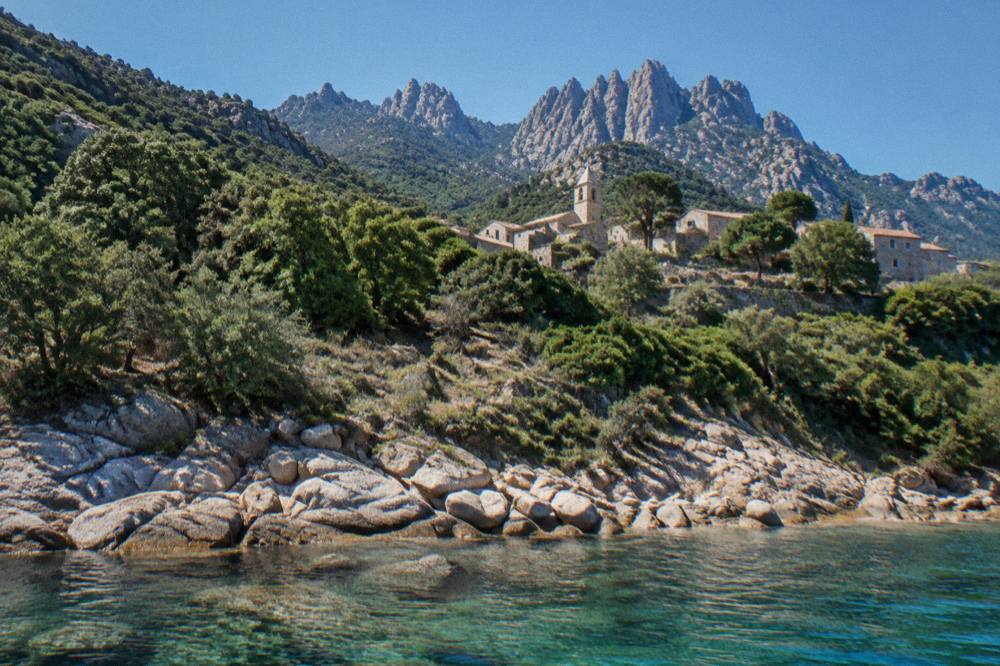
The practical divide is urban versus rural, and coastal versus inland. The Calanques de Piana, the Golfe de Porto and the beaches of Palombaggia and Santa Giulia sit inside a tourism machine where English menus and English-speaking staff are standard in season. Drive an hour into the Castagniccia or up toward the Aiguilles de Bavella, and the balance shifts firmly toward French, with Corsican heard alongside it in many villages.
A handful of phrases changes the tone of every interaction, and Corsicans, like people anywhere, respond well to the effort. Bonjour on entering a shop, merci when served, and au revoir on leaving are the minimum. The table below gives the useful core in both French and Corsican, since greetings in Corsican are welcomed in the island's villages.
| English | French | Corsican |
|---|---|---|
| Hello / good day | Bonjour | Bonghjornu |
| Good evening | Bonsoir | Bona sera |
| Thank you | Merci | Grazie |
| Please | S'il vous plaît | Per piacè |
| Goodbye | Au revoir | A vedeci |
| Do you speak English? | Parlez-vous anglais? | Parlate inglese? |
| Yes / no | Oui / non | Iè / nò |
Emergency situations work in English if needed: 112 is the European emergency number, with 15 for medical, 17 for police, 18 for fire, 114 by SMS or app, and 196 for sea rescue on VHF channel 16. Mountain rescue in Corsica is reached through the PGHM at Ajaccio on 04 95 24 24 00, or via 112. The answers page on Corsica safety covers the wider picture.
What Is The Corsican Language And Where Does It Fit In?
Corsican, a Corsu, is the island's own Romance language, distinct from French, and it is actively supported by the Collectivité de Corse through the Cartula di a lingua corsa and immersion schools; it is heard on the radio, read in local publications and spoken in family and village life, especially in the interior. It does not hold official language status, so French remains the sole language of contracts, courts and state administration in Corsica.
The Collectivité de Corse, the single territorial authority with special status in place since 1 January 2018, runs the language programmes directly. That means the language is not a museum piece: children attend immersion classes, and public life carries Corsican alongside French on signage and in cultural programming. A visitor will hear it most in the villages of the interior, in the Niolu and around Corte, the island's old capital, which sits inland. Everything else covered here is indexed on Corsica Travel Guide.
Street names, village signs and trail markers frequently appear in Corsican, and the island's famous long-distance paths carry Corsican names: the GR20 is also Fra li Monti, and the cross-island trails are Mare a Mare and Mare e Monti. Recognising a few of these names makes a practical difference when reading route descriptions or bus destinations. For background on the island's identity questions, the pages on where Corsica is located and whether Corsica is part of France or Italy go deeper.
How Do Corsica's Museums And Attractions Handle English?
Corsica's major museums serve English speakers through published English information pages rather than full English staffing: Maison Bonaparte and the Musée de la Corse both maintain English practical pages with hours and prices, while boat tour operators sell directly to international customers in English every day. Smaller sites, village museums and municipal attractions often operate in French only, so checking ahead or travelling with a translation app is the practical answer.
The numbers below are the current figures from each institution's own information, and they double as a snapshot of what is documented in English or easily accessible to English speakers.
| Site | Hours | Admission |
|---|---|---|
| Maison Bonaparte, Ajaccio | Every day except Monday; 1 Jul to 30 Sep 10:00 to 17:30 | EUR 10 full, EUR 8 for non-EU residents 18 to 25 and large families, free for EU residents under 26 |
| Palais Fesch, Ajaccio | Daily 09:00 to 17:00, closed Christmas, New Year and 1 Nov | EUR 10 full, EUR 6 over 65, free up to 18 |
| Musée de la Corse and Citadelle de Corte | 1 May to 31 Oct daily 10:00 to 19:00; 1 Nov to 30 Apr 10:00 to 17:00 except Sun, Mon, holidays | EUR 5.50 full, one ticket covers museum and citadel |
| Filitosa prehistoric site | 1 Apr to 2 Nov, 09:00 to sunset | EUR 9 adults, EUR 7 reduced, EUR 28 family |
Filitosa, the prehistoric site near Sollacaro, is a good example of the island's mix: the site's own information is published with an English version, and the family ticket and opening season, 1 April to 2 November, are set out plainly. The Escalier du Roi d'Aragon in Bonifacio, 189 steps cut down the cliff, is booked through the town's reservation system, and closed-toe flat shoes are required; its hours shift by month. None of this demands French fluency, but reading a translated page before arrival saves confusion at the gate.
Can You Hike And Explore Corsica Without French?
You can hike Corsica's waymarked trails without French, because the GR20 and the Mare a Mare and Mare e Monti routes are marked, mapped and booked through systems that work for English speakers, but the booking platform for GR20 refuge nights operates with French conventions and cash-on-site meal payments at the refuges, so preparation in English before departure matters more than language on the trail itself.
The GR20 runs 180 km north to south with about 15 stages of 4 to 8.5 hours, and the Parc naturel régional de Corse guards its refuges from 16 May to 4 October. Booking is mandatory and online only: a bunk costs EUR 20 per person, a bivouac pitch EUR 12, and a rented tent EUR 27 for one person or EUR 39 for two. Meals at the refuges are paid on site in cash or by cheque to the guardian. For a walker with no French, the online booking, a phrase card and cash cover everything the trail asks of you.
Two rules matter more than language on Corsica's mountains. Wild camping is banned across the island, with bivouac allowed only in the marked areas at the refuges, and from 15 June to 30 September lighting fires or smoking in forests, maquis and massifs is forbidden, with the daily fire-risk map updated at 18:00 for the next day. No GR20 departures are allowed from Calenzana after 11:00 under a municipal order. The full picture is on the GR20 difficulty page.
Does Speaking Italian Help In Corsica?
Italian helps in Corsica more than in mainland France, both because Corsican and Italian are close enough that a Spanish or Italian speaker will recognise a great deal of village conversation, and because the island's ferry links to Livorno, Savona, Genoa and Santa Teresa Gallura bring Italian visitors in large numbers, so many shops and restaurants in Bonifacio, Bastia and Calvi handle Italian routinely. For an English speaker with school Italian, it is a useful second key, not a replacement for basic French.
The ferry map explains the Italian presence. Moby sails Livorno to Bastia, Genoa to Bastia and Santa Teresa Gallura to Bonifacio, and Corsica Ferries runs from Toulon, Nice, Livorno and Savona, per its route listing. Bonifacio, the town closest to Sardinia, functions in season almost as a bilingual French-Italian tourist town, with the 50 to 60 minute Sardinia crossing bringing day visitors constantly. Corsica Linea and La Méridionale run the French routes from Marseille.
For context on the island's neighbours, the comparison pages on Corsica versus Sardinia and on getting to Corsica cover the crossings in detail. The essential point for language planning: south-coast tourism staff expect Italian, north-coast and west-coast staff expect a mix, and English sits behind both as the visitor lingua franca.
The Bonifacio sea escape that anchors this page's recommendations is a case study in how language works on the island: a full-day product sold from Ajaccio and Porticcio to an international boatload, with the coastline of the Bonifacio cliffs doing most of the talking. Full details, including departure information and the current rate, sit on the Check availability link, and the site's own Ajaccio city guide covers the town it sails from.
Common Questions About Speaking English In Corsica
Do They Speak English In Corsica?
English is spoken in Corsica's visitor economy: hotels, boat tour operators, major museums, airports and the larger restaurants in tourist centres handle English routinely. Everyday life runs in French, so markets, village shops and public offices do not, and basic French phrases are worth carrying.
Is English Enough For A First Trip To Corsica?
For a trip built on booked tours, museum visits and hotel-based days in Ajaccio, Bonifacio, Porto-Vecchio or Calvi, English is enough. Add a translation app and a phrase card for markets, taxis, village bakeries and anything administrative.
What Language Do People In Ajaccio And Bastia Speak?
Ajaccio, with 76,320 residents, and Bastia, with 46,867, are French-speaking towns, with Corsican present in cultural life and English present in the waterfront businesses that serve visitors and ferry passengers.
Is Corsican The Same As French?
No. Corsican is a distinct Romance language, closer to Italian, and it is supported by the Collectivité de Corse through the Cartula di a lingua corsa and immersion schools. French is the language of administration and daily commerce.
Do Corsican Tour Guides Speak English?
The island's boat trips, walking tours and jeep excursions sell to an international market, and their operators provide commentary for English speakers as standard practice. Booking a guided product is the simplest way to guarantee English commentary.
In short, Corsica will not test your French the way a rural mainland département might, because the sea that surrounds it delivers an international crowd every summer, but it rewards anyone who arrives with bonjour and merci ready. Between the English-facing tour desks, the museums with English information pages and a phrase card for the villages, an English speaker can move comfortably from the Îles Sanguinaires to the Aiguilles de Bavella.