Is Corsica Part Of France Or Italy?
Corsica is a French island in the Mediterranean, not part of Italy. This guide explains its status, government, language, currency and how to reach it from France or Italy.
Corsica is part of France. It is a French island in the Mediterranean, lying closer to the Italian coast than to the French mainland, and it has been a French territory for well over two centuries, though the pages here stick to what official sources state rather than to historical narrative. The island covers 8,722 km2, which makes it the fourth-largest island in the Mediterranean, with more than 1,000 km of coastline and a mountainous interior topped by Monte Cinto at 2,706 m. It is home to 365,636 people according to the provisional INSEE estimate for 1 January 2026. The Corsica Travel Guide covers the whole island, and this page answers the France-or-Italy question, plus a look at how the island is governed, what language is spoken there and how you reach it from either country.
Corsica is part of France, and it is not part of Italy in any administrative sense. It is a French island in the Mediterranean with its own single territorial authority, the Collectivité de Corse, in place since 1 January 2018. The currency is the euro, the emergency and administrative systems are French, and the island's two departments are Corse-du-Sud and Haute-Corse.
The island's position explains why the question gets asked at all. Corsica sits in the Mediterranean with the Italian island of Sardinia just to the south, and ferry links run between Bonifacio and the Sardinian port of Santa Teresa Gallura in roughly 50 to 60 minutes, a crossing operated by Moby and Ichnusa Lines. Italy is genuinely close. Yet every institutional fact about the island is French. The towns of Ajaccio, with 76,320 residents, and Bastia, with 46,867, are French communes, counted by INSEE like any others, and the island's 360 communes sit inside the French administrative structure.
The Collectivité de Corse is reported to be a single territorial authority with special status, replacing the former collectivity and the two departmental councils on 1 January 2018. It runs island-level competences from its seat in Ajaccio. That arrangement does not make Corsica independent or associate it with Italy; it is a form of devolved self-government inside the French Republic, comparable in spirit to other French territorial collectivities with special status.
| Question | Answer |
|---|---|
| Which country does Corsica belong to? | France |
| Is Corsica in Italy? | No |
| Currency | Euro |
| Island area | 8,722 km2 |
| Population | 365,636 |
| Main towns | Ajaccio 76,320, Bastia 46,867 |
For travellers, the practical consequences are simple. You enter France when you enter Corsica, so the entry rules are the French ones, and the travel documents, the currency and the emergency numbers are all those of France. The question where Corsica is located is covered in its own page, including the island's position between the French and Italian coasts.
What Is The Collectivité De Corse?
The Collectivité de Corse is a single territorial authority with special status that has governed the island since 1 January 2018 replacing the earlier territorial collectivity and the two departmental councils. It sits in Ajaccio and runs island-level matters, while Corsica remains fully part of the French Republic with the two departments Corse-du-Sud and Haute-Corse.
The reform that created the single collectivity merged island-level institutions, but it did not change the country. Corse-du-Sud, with about 175,100 residents, and Haute-Corse, with about 190,500, remain the island's two departments in the INSEE 2026 estimates. The collectivity runs practical services, and it also runs Corsican-language programmes, including the Cartula di a lingua corsa and immersion schools.
This linguistic side of the island's public life is one reason the France-or-Italy question keeps coming up. Corsican is taught, broadcast and supported by the collectivity's own programmes, and Italian is a neighbouring country's language rather than an administrative one on the island. The page on whether they speak English in Corsica goes further into the languages you actually hear, and what Corsica is famous for covers the cultural signature of the island.
Geographically, the island is unambiguous about its sea-surrounded nature. There are beaches, coves, ports and ferry terminals on every side, and the interior, around Corte and the high valleys, is the inland part. The regional natural park, the Parc naturel régional de Corse, created in 1972, now covers 4,484 km2, more than half the island.
Do You Need A Passport To Visit Corsica From Italy?
You cross from Italy into France when you take the Bonifacio to Santa Teresa Gallura ferry or fly from an Italian airport into Corsica, so the entry rules that apply are France's rules, part of the Schengen framework. Inside Schengen there are normally no systematic border checks, but you still carry the ID your own country requires for travel, and non-EU visitors need the documents France requires.
The sea crossing between Sardinia and Corsica is short, about 50 to 60 minutes as reported, but it is an international one. Moby and Ichnusa Lines kept the Santa Teresa Gallura to Bonifacio route after Sardinia found no rival operator, a decision reported in October 2026, so the link is stable. Travelers connecting through Italy should read the dedicated pages on how to get to Corsica and whether you need a car in Corsica before planning the onward journey, because the island's mountain roads and thin public transport change the calculus.
Money is straightforward: the euro is used on both sides of that strait, and the page on what currency is used in Corsica covers the practical details. The tipping culture is the French one, with service included in menu prices by law and any extra tip optional. The page on whether Corsica is in the Schengen area answers the border question in full.
How Do Ferries Connect Corsica To France And Italy?
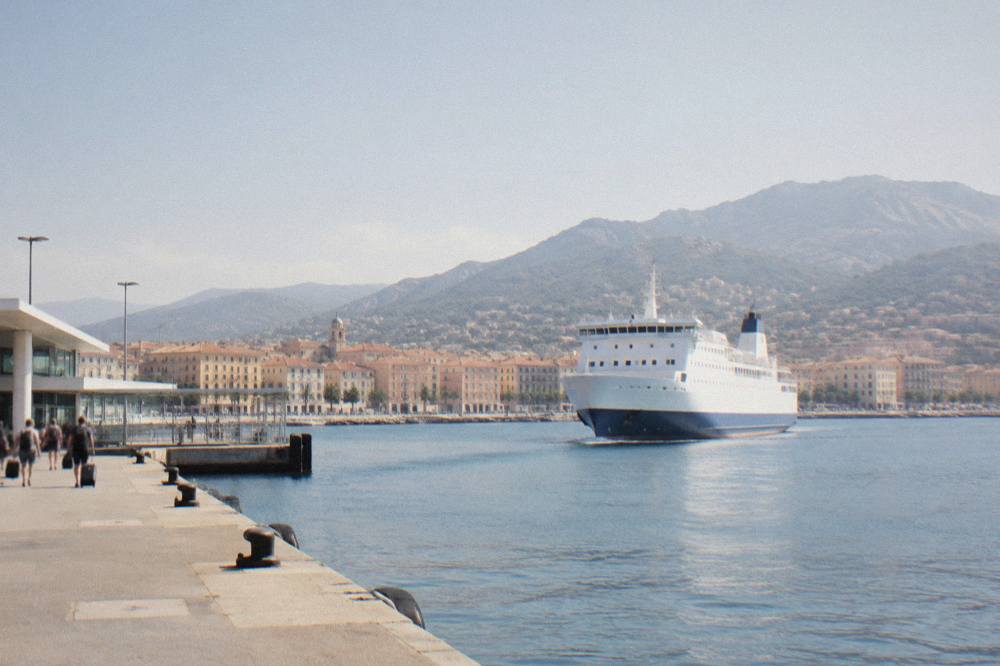
Ferries link Corsica to both countries: from France, Corsica Linea sails Marseille to Ajaccio, Bastia, Propriano and L'Île-Rousse, and La Méridionale sails Marseille to Ajaccio and Porto-Vecchio; from Italy, Moby sails Livorno and Genoa to Bastia and Santa Teresa Gallura to Bonifacio, and Corsica Ferries is reported to sail from Livorno and Savona to Bastia and from Toulon and Nice.
The French connections are mostly long overnight crossings, with the Marseille routes reported at roughly 12 to 13 hours. The Italian connections are shorter: Livorno to Bastia is reported at about 4 to 5 hours and Savona to Bastia at about 6.5 hours. Nice to Bastia is reported at about 7.5 to 10 hours. These crossing times are aggregator figures and are quoted as ranges, so confirm the sailing you book against the operator's own timetable. More of these guides are collected on Corsica Travel Guide.
| Mainland port | Corsican ports | Operators | Crossing time |
|---|---|---|---|
| Marseille | Ajaccio, Bastia, Propriano, L'Île-Rousse | Corsica Linea; La Méridionale to Ajaccio and Porto-Vecchio | About 12-13 h |
| Toulon and Nice | Ajaccio, Bastia, L'Île-Rousse, Porto-Vecchio, Propriano | Corsica Ferries | About 10-13 h from Toulon; 7.5-10 h from Nice |
| Livorno | Bastia | Corsica Ferries and Moby | About 4-5 h |
| Savona | Bastia | Corsica Ferries | About 6.5 h |
| Genoa | Bastia | Moby | Seasonal sailing |
| Santa Teresa Gallura | Bonifacio | Moby and Ichnusa Lines | About 50-60 min |
Flying is the other option, and the island has four airports: Ajaccio Napoléon Bonaparte (AJA), Bastia Poretta (BIA), Figari Sud Corse (FSC) and Calvi Sainte-Catherine (CLY). More than 8.5 million passengers, excluding cruise passengers, passed through Corsica's ports and airports in 2025 according to the ORTC and DREAL annual report published 30 May 2026.
Is Corsican Culture French Or Italian?
Corsican culture is its own, inside a French political framework. The Collectivité de Corse runs Corsican-language programmes including immersion schools, the island's food carries its own protected appellations such as brocciu and Corsican charcuterie, and its music and traditions are documented as distinct. None of that makes the island Italian: politically and administratively it is French, and culturally it is Corsican first.
The food system makes the point well. Brocciu obtained its appellation d'origine in 1983, and the three charcuterie cuts prisuttu, lonzu and coppa received AOC status in 2012 and AOP status in 2014. Chestnut flour, Corsican honey and Corsican olive oil all carry protected names, and the Clémentine de Corse holds an IGP. These are European protections registered for Corsican products, applied within the French system. The pages on Corsican food and the famous drink of Corsica cover the table in detail.
The flag question follows the same logic. The Moor's head flag is a Corsican symbol, not a national one, and the page on what the Corsican flag means explains it. If the question behind your search is whether the island feels like one country or the other, the honest answer from every source here is that it feels like Corsica: French in administration and currency, Mediterranean in setting, with its own protected foods, its own language programmes and its own long-distance trails such as the GR20, whose 180 km route crosses the island's mountainous spine from north to south.
A sunset boat trip is a good way to see the island's French-Mediterranean character from the water.
Does Corsica Use French Law And French Emergency Services?
Yes. Emergency numbers on the island are the French ones, 112 for the European emergency line, 15 for medical, 17 for police, 18 for fire, 114 by SMS or app and 196 for sea rescue, with mountain rescue handled by the PGHM in Ajaccio on 04 95 24 24 00. Consumer rules, tipping law and administrative services are all French, and the euro is the currency.
That extends to travel safety advice. The UK FCDO notes a high risk of wildfires in France during the summer season, April to October, and from 15 June to 30 September it is forbidden to light fires or smoke in forests, scrub and massifs across the island. The US State Department lists France at Level 2, Exercise Increased Caution, reported advice that applies nationwide. The pages on whether Corsica is safe for tourists and whether it is safe to hike the GR20 alone cover the practical side.
Road rules are French too, and Inforoutes Corse publishes live road conditions and accessibility levels for the main mountain passes, which matters on an island where the interior roads are narrow and the col statuses change with the season. Speed limits and driving conventions follow French rules.
Common Questions About Corsica And Its Country
Is Corsica Part Of France Or Italy?
Corsica is part of France. It is a French island in the Mediterranean governed by the Collectivité de Corse, a single territorial authority with special status reported to be in place since 1 January 2018. It is not part of Italy, though Sardinia lies just across the strait from Bonifacio.
What Is The Capital Of Corsica?
Ajaccio is the capital, with 76,320 residents in the INSEE 2023 census population. Bastia, with 46,867 residents, is the island's second town. See what the capital of Corsica is for the full answer.
Do They Speak Italian In Corsica?
Italian is not an administrative language on the island. The Collectivité de Corse runs Corsican-language programmes, including the Cartula di a lingua corsa and immersion schools, and French is the language of administration and public life.
Is Corsica Closer To France Or Italy By Ferry?
By sailing time the Italian links are shorter: Livorno to Bastia is reported at about 4 to 5 hours and Santa Teresa Gallura to Bonifacio at about 50 to 60 minutes, against about 12 to 13 hours reported for the Marseille crossings.
Can You Visit Corsica And Italy On The Same Trip?
Yes. Moby and Ichnusa Lines run the Bonifacio to Santa Teresa Gallura crossing, so a combined Corsica and Sardinia itinerary is practical. The page on whether Corsica is better than Sardinia compares the two islands.
What Currency Does Corsica Use?
The euro, like the rest of France. Local costs such as museum tickets are quoted in euros, and service is included in restaurant prices by French law.
The short answer stands: Corsica is French, its institutions are French, and its character is its own. Whether you arrive by overnight ferry from Marseille or a short hop from Sardinia, the island that receives you is the Collectivité de Corse, 8,722 km2 of mountains and more than 1,000 km of coastline, firmly part of France.