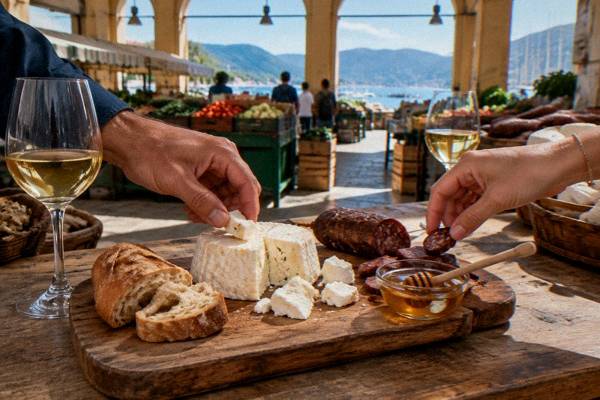
Restaurants In Corsica
Corsica's restaurant tables run on protected island produce: brocciu, charcuterie from the Nustrale pig, chestnut flour, olive oil, honey and wine, all framed by more than 1,000 km of coastline and a mountainous interior.
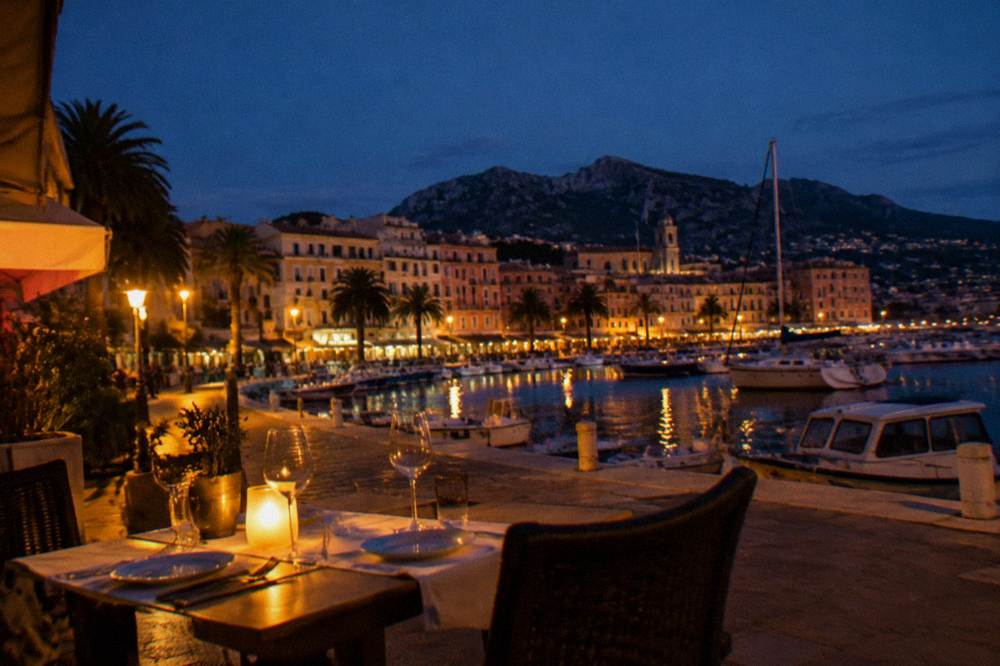
Corsican restaurants build menus around AOP and AOC island products such as brocciu, prisuttu, lonzu, coppa, chestnut flour, olive oil and honey, served with Corsican wines like Patrimonio and Ajaccio; the main eating towns are Ajaccio, Bastia, Bonifacio, Calvi, Porto-Vecchio and Corte.
Corsica eats from its own larder. This French Mediterranean island, 8,722 km2 with more than 1,000 km of coastline and an interior that rises to Monte Cinto at 2,706 m, puts protected island produce at the centre of the restaurant table: brocciu cheese, charcuterie from the Nustrale pig, chestnut flour, olive oil, honey and wine, much of it under AOP or AOC labels. Service is included in menu prices by law, so a bill in Ajaccio or Bonifacio works the way it does anywhere in France. This page from Corsica Travel Guide lays out what to order, where the island's eating towns sit, and which food and wine tours cover the ground, with everything sourced from official product and tourism pages.
What Food Defines Restaurants In Corsica?
Corsican restaurant menus are built on the island's own protected produce: brocciu, which obtained its appellation d'origine in 1983, charcuterie from the Nustrale pig, chestnut flour, olive oil, honey and clémentine de Corse, alongside island appellations of wine. The classic names to look for are brocciu, prisuttu, lonzu, coppa, figatellu, fiadone and canistrelli, and most of the island's flagship products carry an AOP or AOC label with a date.
The backbone of the table is the charcuterie board. Three cuts, prisuttu, lonzu and coppa, received AOC protection in 2012 and AOP status in 2014, and the Nustrale pig breed behind them was recognised in 2006. Brocciu, the island's best known cheese, obtained its appellation d'origine in 1983, with AOC and AOP status reported from 1998. Beyond the board, olive oil has carried the AOC "Huile d'olive de Corse - Oliu di Corsica" since 2004, chestnut flour holds the AOP "Farine de châtaigne corse - Farina castagnina corsa", and the AOP "Miel de Corse - Mele di Corsica" covers island honey.
The sweet side of the card is short and definite. Fiadone and canistrelli are the dessert and biscuit names that recur across the island, and the clémentine de Corse holds an IGP dating to 2007 with a Label Rouge from 2014. The eastern plain around the island's citrus groves supplies that fruit, and CESEC data from the 2014 era put about 98 percent of metropolitan France's citrus area in Corsica, a figure tied to that period rather than to today. For planning what a food trip costs end to end, the Corsica cost and budget guide breaks the island's spending picture down.
A useful habit on any Corsican menu is to read for the label names rather than the dish names alone. A card that names brocciu, farina castagnina corsa or mele di Corsica is telling you which protected products the kitchen buys, and the dates in the table further down this page explain what each designation covers. The dishes themselves stay lowercase on menus and in speech, figatellu, fiadone, canistrelli, brocciu, in line with Corsican usage.
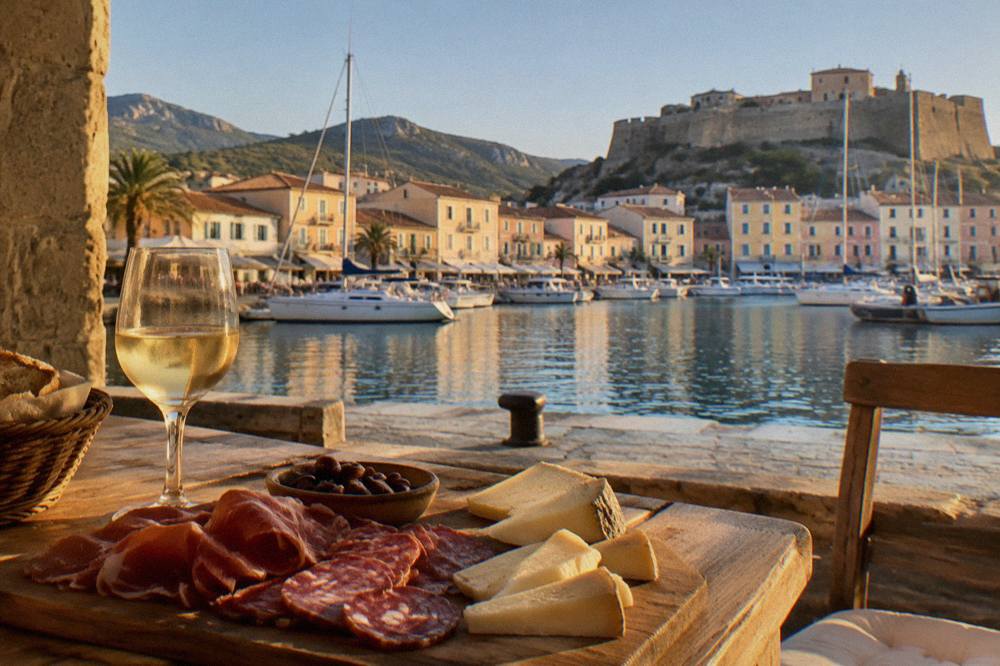
Which Corsican Products Carry Protected Status?
Corsica holds protected designations across cheese, charcuterie, flour, oil, honey and citrus: brocciu's appellation d'origine dates to 1983, prisuttu, lonzu and coppa took AOC in 2012 and AOP in 2014, chestnut flour carries its own AOP, olive oil's AOC took effect in 2004, honey holds an AOP, and the clémentine de Corse has an IGP from 2007. Each label ties the product to the island by rule, not custom.
The designations matter on a menu because they are legal, not decorative. A brocciu made under its appellation follows a defined production rule, the same principle that governs the three charcuterie cuts and the flour milled from island chestnuts. The defence body for the chestnut flour AOP was created in 2001, years before the recognition itself, which shows how long the island's producers worked to lock these names down. The table below gathers the dates as the official and reported sources give them.
| Product | Designation | Year |
|---|---|---|
| Brocciu | Appellation d'origine | 1983 |
| Brocciu | AOC / AOP | 1998 |
| Prisuttu, lonzu, coppa | AOC | 2012 |
| Prisuttu, lonzu, coppa | AOP | 2014 |
| Nustrale pig breed | Breed recognition | 2006 |
| Chestnut flour (Farina castagnina corsa) | AOP | Recognition reported 2010 |
| Olive oil (Oliu di Corsica) | AOC | 2004 |
| Honey (Mele di Corsica) | AOP | Exists; 1998 AOC reported |
| Clémentine de Corse | IGP (Label Rouge 2014) | 2007 |
Wine belongs in the same protected family. Corsican appellations reported by the island's tourism body include Patrimonio, Ajaccio, Vin de Corse with its named crus such as Calvi, Coteaux du Cap Corse, Figari, Porto-Vecchio and Sartène, and Muscat du Cap Corse. The grape names that recur are Nielluccio and Sciaccarellu for the reds and Vermentinu for the whites. A wine list in Corsica therefore reads as a map of the island: Patrimonio and the Coteaux du Cap Corse at the northern tip, Ajaccio on the west coast, and the Vin de Corse crus strung along the east and south.
Where Should You Eat In Ajaccio And Bastia?
Ajaccio, the island's capital with 76,320 residents, and Bastia, its second town with 46,867, hold the largest restaurant scenes in Corsica, and both anchor their cards in island produce and Corsican wine. Ajaccio pairs its tables with Napoleon-era sights such as Maison Bonaparte, open every day except Monday at EUR 10 full price, while Bastia's eating sits around its old harbour and the Musée de Bastia's seasonal hours.
Ajaccio works as a food base because the town is compact around its sights. Maison Bonaparte on Rue Saint-Charles sits 200 m from the bus station and ferry terminal, with bus 8 from the airport, and Palais Fesch, at EUR 10 full price and EUR 6 for over 65s, free up to 18, opens daily 09:00 to 17:00 under the current tourist-office listing for 16 January to 31 December 2026. Maison Bonaparte's own seasons run 10:00 to 17:30 continuous from 1 July to 30 September, with split morning and afternoon hours the rest of the year. A day of museums and menus needs no car.
Bastia, the island's northern gateway, is where the ferry from Livorno, Genoa and Savona lands eaters directly into town. The Musée de Bastia in the Palais des Gouverneurs runs high-season hours of 10:00 to 18:30 and low-season hours of 09:00 to 12:00 and 14:00 to 17:00, closed Sundays and Mondays, as reported by the museum. Between the old harbour and the citadel, the eating runs on the same island larder, and the town's size means everything sits within a short walk of the port. Bastia's density, 2,418 residents per km2, makes it the tightest urban eating quarter on the island.
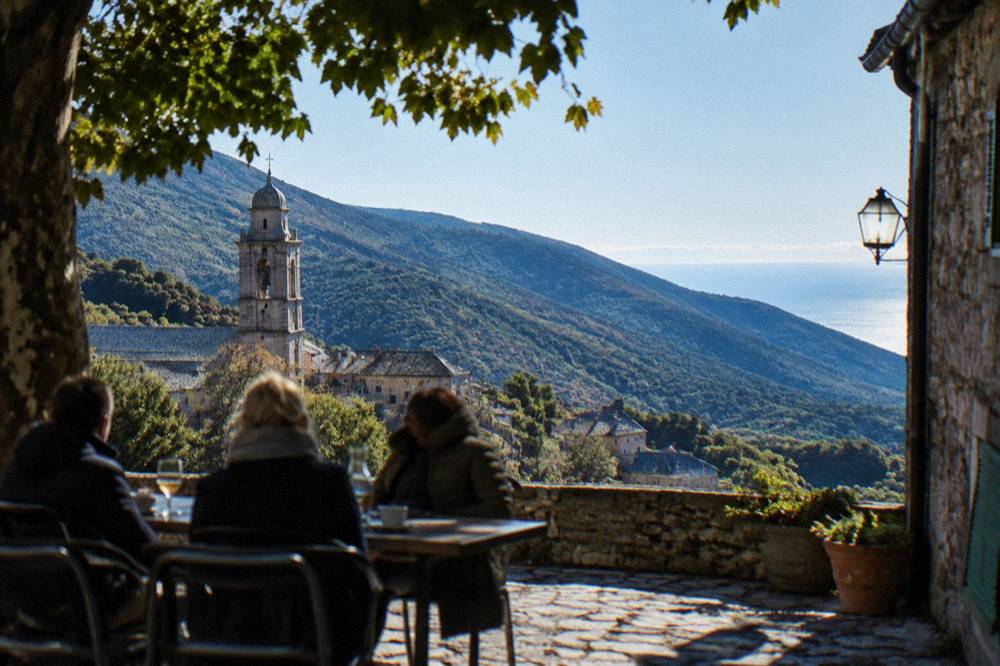
The single fastest introduction to the Ajaccio table is the Ajaccio Local Food Tour with Tastings, a small-group walk built around island tastings: Check availability.
What Should You Know About Eating Along The Corsican Coast?
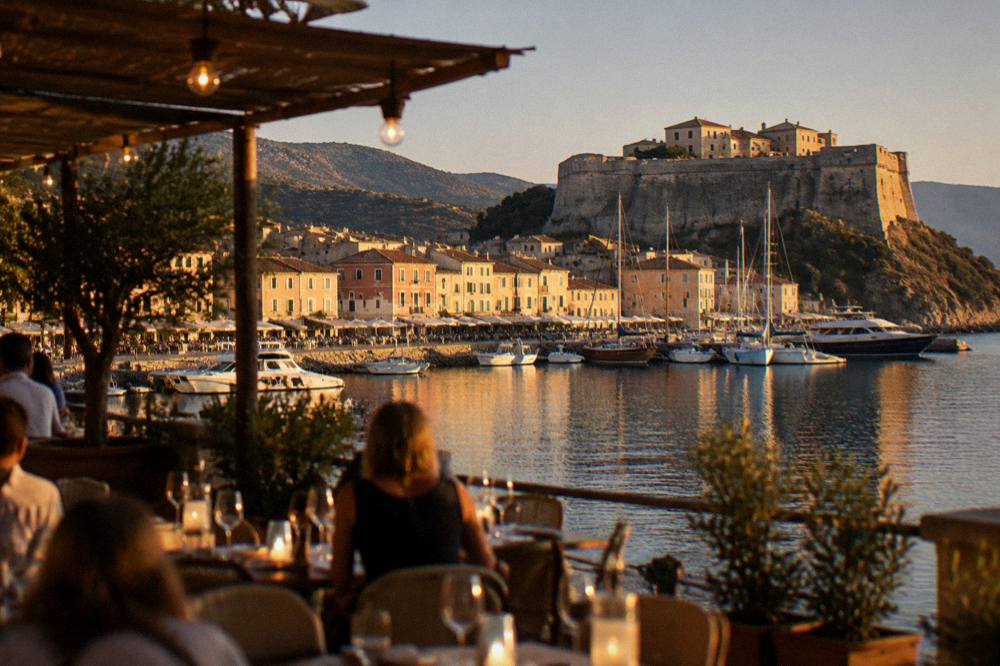
Corsica's coastal restaurant towns, Bonifacio, Porto-Vecchio, Calvi, L'Île-Rousse, Saint-Florent and Propriano, all sit on the sea, with more than 1,000 km of coastline behind them, and their tables draw on the island's protected produce and the day's catch. Bonifacio pairs its cliffside setting with the Escalier du Roi d'Aragon, 189 steps cut down the cliff, and Filitosa's prehistoric site lies inland from Porto-Vecchio at EUR 9 adult entry.
The south coast concentrates the island's best known resort eating. Porto-Vecchio and Bonifacio sit close to the beaches of Palombaggia, Santa Giulia and Rondinara, and to the Îles Lavezzi inside the Bouches de Bonifacio Nature Reserve, so a morning on the water and a long lunch in town fit the same day. Filitosa, open 1 April to 2 November with adults at EUR 9, a reduced rate of EUR 7 and a family ticket at EUR 28, breaks up the drive between the two towns, and the site's own page suggests allowing about 1 hour 30 for a visit.
The west and northwest coasts run from the Golfe de Porto, part of the UNESCO property "Gulf of Porto: Calanche of Piana, Gulf of Girolata, Scandola Reserve" inscribed in 1983, up through Calvi and L'Île-Rousse in the Balagne. Corte, the island's old capital, sits inland at the junction of the mountain routes, with road times of 1 hour from Bastia, 1 hour 30 from Ajaccio and Calvi, 2 hours from Porto-Vecchio, 2 hours 45 from Bonifacio and 2 hours 45 from Propriano per the Musée de la Corse's own directions page, where one ticket at EUR 5.50 covers both the museum and the citadel. The Corsica beaches guide maps the swimming stops between meals.
Which Food And Wine Tours Cover Corsican Cooking?
The island's bookable food and wine offering clusters in Ajaccio and the Balagne: a small-group local food tour with tastings and a second Ajaccio food walk in the capital, wine tastings around Calvi and Île-Rousse in both shared and private formats, and two Corsican-meal experiences built around the Napoleon cave site.
Ajaccio holds the deepest food-tour inventory. The Local Food Tour with Tastings runs as a small-group walk, the No Diet Club food tour covers the same ground in English or French, and the Napoleon's Cave experiences pair a visit with a Corsican meal, one as a basic entry and one as a complete package. In the Balagne, the wine tastings around Calvi and Île-Rousse and the private Corsican wine tour with picnic cover the region's appellations, including the Calvi cru of the Vin de Corse.
| Tour | Base | Format |
|---|---|---|
| Local Food Tour with Tastings | Ajaccio | Small group, tastings |
| No Diet Club food tour | Ajaccio | Shared walk, English or French |
| Napoleon's Cave with Corsican meal | Ajaccio | Entry plus meal |
| Napoleon Cave complete package | Ajaccio | Meal package |
| Wine tastings around Calvi & Île-Rousse | Calvi / Île-Rousse | Wine tasting |
| Corsican Wine Tour & Picnic in Calvi | Calvi | Private, wine tasting |
For eaters who want the table plus the trail, the hiking in Corsica guide covers the long-distance routes, including the GR20's 180 km and about 15 stages, and the things to do in Corsica page indexes the whole island. A food trip also pairs naturally with a boat day: the Golfe de Porto cruises, the Lavezzi catamarans from Bonifacio and the Sanguinaires trips from Ajaccio all end back in a port with restaurants a few steps from the quay.
How Do You Reach Corsica's Restaurant Towns?
Corsica is reached by air through four airports, Ajaccio Napoléon Bonaparte (AJA), Bastia Poretta (BIA), Figari Sud Corse (FSC) and Calvi Sainte-Catherine (CLY), and by sea through ferry ports at Ajaccio, Bastia, Bonifacio, L'Île-Rousse, Propriano and Porto-Vecchio, with more than 8.5 million passengers passing through the island's ports and airports in 2025 excluding cruise passengers.
The ferry map matters for food travellers because the ports land you inside the eating towns. Corsica Linea sails Marseille to L'Île-Rousse, Bastia, Propriano and Ajaccio; La Méridionale sails Marseille to Ajaccio and Porto-Vecchio; Moby sails Livorno to Bastia, Genoa to Bastia and Santa Teresa Gallura to Bonifacio; and Corsica Ferries is reported to sail from Toulon and Nice to the main ports and from Livorno and Savona to Bastia. The short Sardinia link, Santa Teresa Gallura to Bonifacio, runs about 50 to 60 minutes, and Moby and Ichnusa Lines keep that route after Sardinia found no rival operator, per a report of 9 October 2026.
| Operator | Routes |
|---|---|
| Corsica Linea | Marseille to Ajaccio, Bastia, Propriano, L'Île-Rousse |
| La Méridionale | Marseille to Ajaccio, Marseille to Porto-Vecchio |
| Moby | Livorno to Bastia, Genoa to Bastia, Santa Teresa Gallura to Bonifacio |
| Corsica Ferries | Toulon and Nice to Ajaccio, Bastia, L'Île-Rousse, Porto-Vecchio, Propriano; Livorno and Savona to Bastia |
| Airport | Code |
|---|---|
| Ajaccio Napoléon Bonaparte | AJA |
| Bastia Poretta | BIA |
| Figari Sud Corse | FSC |
| Calvi Sainte-Catherine | CLY |
Once on the island, a car is the usual tool for linking restaurant towns, and the Corsica car rental and driving in Corsica pages cover the practical side, including the live road-status service for the mountain passes. The ferry to Corsica guide handles the sea crossing in detail, and the getting around Corsica guide covers the island's train lines, which run Ajaccio to Bastia via Corte, Ponte-Leccia to Calvi, and the Balagne coastal line between Calvi and L'Île-Rousse.
What Do The Climate Normals Mean For Eating Outdoors In Corsica?
Corsica's climate runs hot and dry in summer and mild and wet in winter, per the Météo-France station normals for 1991 to 2020, so terrace eating in Ajaccio means average daily highs of 28.6 °C in July and 29.2 °C in August against 8.6 mm and 15.8 mm of rain, while November carries 111.8 mm of rain and October 85.7 mm, and winter highs still reach 14.0 °C in January with snow only on the high mountains.
The monthly picture below is the Ajaccio (Campo dell'Oro) station data, 1991 to 2020. October and November carry the highest rain totals on the table, July the lowest, and the figures are averages, not forecasts. Bastia's station normals tell a similar story with higher autumn rain totals, 134.3 mm in November and 126.5 mm in October, which is worth knowing if a food trip leans toward the Cap Corse and Patrimonio end of the island. The Corsica weather by month guide expands on the same data.
| Month | High °C | Low °C | Rain mm | Sunshine h/day |
|---|---|---|---|---|
| Jan | 14.0 | 4.7 | 54.1 | 4.4 |
| Feb | 14.2 | 4.3 | 48.1 | 5.5 |
| Mar | 16.0 | 5.9 | 50.4 | 6.8 |
| Apr | 18.5 | 8.3 | 53.1 | 7.7 |
| May | 22.1 | 11.8 | 49.8 | 9.3 |
| Jun | 25.9 | 15.4 | 25.9 | 11.1 |
| Jul | 28.6 | 17.7 | 8.6 | 12.1 |
| Aug | 29.2 | 18.1 | 15.8 | 11.1 |
| Sep | 26.1 | 15.4 | 57.8 | 8.7 |
| Oct | 22.8 | 12.6 | 85.7 | 6.7 |
| Nov | 18.3 | 9.0 | 111.8 | 4.7 |
| Dec | 15.1 | 5.8 | 73.9 | 4.0 |
One summer rule shapes mountain lunches: from 15 June to 30 September it is forbidden to light a fire or smoke in forests, maquis and massifs, which is why barbecue menus move to the coast in that window. The same rule sits behind the GR20's ban on departures from Calenzana after 11:00 in the high-risk period, and the fire-risk map is updated at 18:00 each day for the following day. The best time to visit Corsica guide weighs the same data for the trip as a whole.
How Does Paying And Tipping Work In Corsican Restaurants?
Service is included in the menu price by law across France, and Corsican menus must state "prix service compris" with the service percentage, so the bill you are quoted in Ajaccio or Bastia already carries the service charge and an extra tip is optional rather than expected, per the French DGCCRF's own guidance on pourboires. The currency is the euro throughout the island.
This is the same rule that applies on the mainland, and it simplifies a food trip: the printed price is the price. Emergency and practical numbers are equally standard, with 112 as the European emergency number, 15 for medical, 17 for police, 18 for fire, 114 by SMS or app and 196 for sea rescue, and the PGHM mountain rescue base at Ajaccio on 04 95 24 24 00. The Corsica safety guide and Corsica travel tips pages carry the fuller practical picture.
Can You Build A Whole Trip Around Corsican Food?
Yes, because the island's food geography spans a single week of driving: brocciu and charcuterie from the interior, wine from Patrimonio, Ajaccio and the Vin de Corse crus, olive oil and honey under their own AOPs, seafood along the whole coast, and the clémentine de Corse from the eastern plain, all reachable on roads that link Ajaccio, Corte, Calvi, Porto-Vecchio and Bonifacio inside a loop of a few hours' driving each day.
A food loop works clockwise. Start in Ajaccio for the markets and the food tours, drive the interior to Corte for the Musée de la Corse and the mountain larder, drop to the Golfe de Porto for the UNESCO inscribed coast, then north through Calvi and L'Île-Rousse for the Balagne's wine and olive country before returning along the Cap Corse to Bastia and Patrimonio. The Corsica map guide and the where to stay in Corsica guide handle the overnight stops, and the luxury hotels in Corsica guide covers the top end.
Common Questions About Restaurants In Corsica
What Is The Most Famous Food In Corsica?
Brocciu, the cheese that obtained its appellation d'origine in 1983, and the charcuterie trio of prisuttu, lonzu and coppa, AOC since 2012 and AOP since 2014, anchor the island's table, with figatellu, fiadone and canistrelli as the other recurring names.
Is Service Included In Corsican Restaurants?
Yes. Menus in France must state "prix service compris" with the service percentage, so the printed price already includes service and an additional tip is optional.
Which Corsican Products Have AOP Status?
Prisuttu, lonzu and coppa (AOP 2014), brocciu (AOP reported from 1998), chestnut flour under Farina castagnina corsa, olive oil under Oliu di Corsica, and honey under Mele di Corsica all carry protected labels.
What Wine Should You Order In Corsica?
The island's appellations include Patrimonio, Ajaccio, Vin de Corse with crus such as Calvi, Coteaux du Cap Corse, Figari, Porto-Vecchio and Sartène, and Muscat du Cap Corse, made from Nielluccio and Sciaccarellu reds and Vermentinu whites.
Are There Food Tours In Corsica?
Yes, concentrated in Ajaccio and the Balagne: the Local Food Tour with Tastings and the No Diet Club walk in the capital, and the wine tastings and private wine tour with picnic around Calvi and Île-Rousse.
When Can You Eat Outdoors In Corsica?
The Météo-France 1991-2020 normals for Ajaccio show average daily highs of 22.1 °C in May, 28.6 °C in July and 26.1 °C in September, with November carrying 111.8 mm of rain, so terrace season spans late spring to early autumn on the averages.
Eating in Corsica means ordering from an island that protects its own larder, from the 1983 brocciu appellation to the 2014 AOP on its charcuterie, and every restaurant town on the coast or in the interior serves from that same protected stock. Pick a base, book a tasting walk in Ajaccio or a wine table in the Balagne, and let the labels on the menu do the rest.